First Complete Connectome of Adult Fruit Fly Unveils Brain-Body Neural Networks, Advancing AI and Robotics Research
June 9, 2026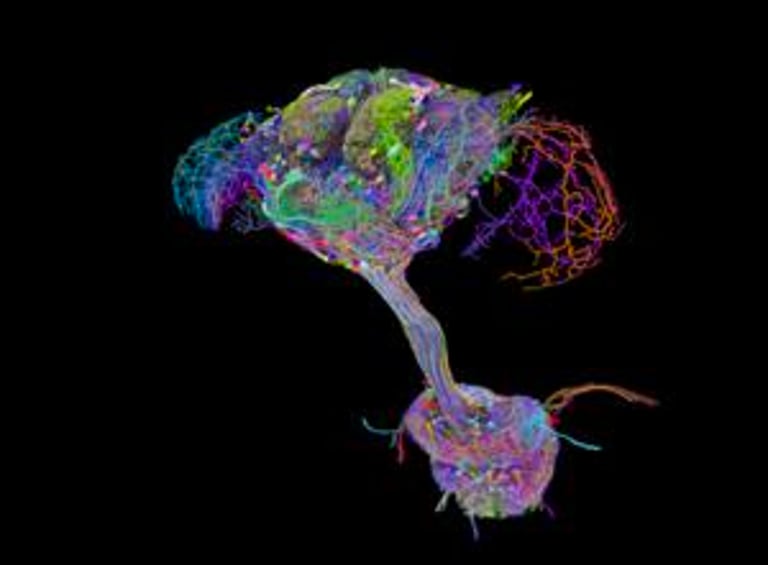

A complete central nervous system connectome of an adult fruit fly has been mapped, integrating the brain with the nerve cord to show full information flow from sensation to action across the organism.
The connectome maps all neuronal connections at the synapse level and is freely available online to the research community, enabling holistic study of brain–body interactions and behavior.
This work bridges prior brain-only maps by including the nerve cord, enabling hypotheses about motor control and behavior to be tested in a holistic brain–body context.
The project was supported by NIH, NSF, BRAIN Initiative, and other funders, with several authors and institutions disclosing financial interests and patent considerations related to the work and related technologies.
The research has implications for artificial intelligence and robotics by showing how decentralized, embodied networks can efficiently coordinate actions and navigate environments, informing future AI agent design.
Future directions include adding neuropeptide data to the connectome, expanding to more complex organisms, and exploring whether distributed control is conserved across species, including potential implications for human neuroscience and AI design.
The dataset is open-source and freely available online, funded by the BRAIN Initiative, NIH, and NSF, intended as a benchmark for computational neuroscience and mammalian comparisons, akin to the Human Genome Project.
The study, titled Distributed control circuits across a brain-and-cord connectome, was published in Nature on June 8, 2026.
Key finding: many behaviors are controlled by local, body-part–specific neural circuits rather than a single centralized brain hub, indicating distributed control of movement and action.
Representative findings show motor control is largely local to each limb with interconnections coordinating complex movements like walking; wings and other appendages participate with feedback from sensory and endocrine systems.
Methodology involved thousands of serial ultrathin sections imaged by electron microscopy, with AI-assisted alignment to create a high-resolution, synapse-level wiring diagram now publicly available as the BANC-FlyWire dataset.
The study describes a multi-step process of preparing serial sections, imaging with electron microscopy, and using AI to assemble a cohesive 3D map linking brain and body circuits through identifiable neurons.
Summary based on 3 sources
Get a daily email with more Science stories
Sources
Neuroscience News • Jun 8, 2026
Complete Drosophila Nervous System Mapped
EurekAlert! • Jun 8, 2026
Researchers publish first complete connectome of fruit fly brain and ‘spinal cord’