AI-Powered Digital Twin Revolutionizes Permafrost Prediction, Enhances Infrastructure Resilience
June 16, 2026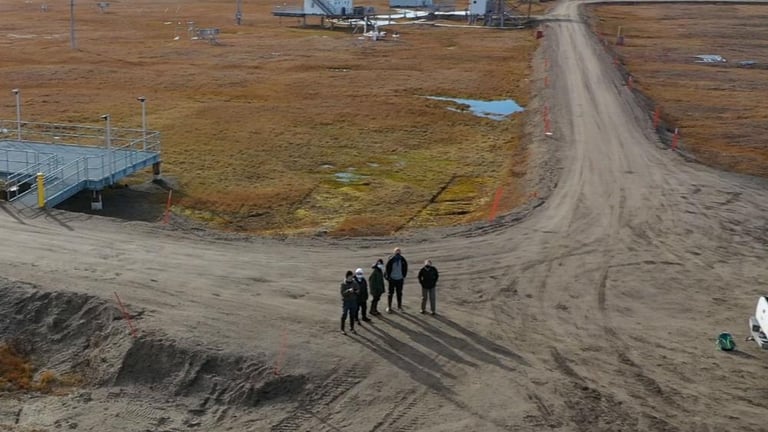

A Penn State–led team built a digital twin that fuses a physics/AI heat-transfer model with real-time data from long fiber-optic seismic and temperature cables, updating as new measurements roll in.
The system relies on two integrated models: a physics/AI forecast of ground heat transfer and a real-time data stream from fiber-optic sensing, enabling near real-time simulation and updates.
The twin continuously ingests data from the one-kilometer fiber-optic network to refine predictions of permafrost properties such as unfrozen water content, ground temperature, and heat-transfer pathways.
The work was published in JGR Earth Surface and highlighted in Eos Magazine, with funding from the National Science Foundation and collaboration among Penn State researchers and partners across institutions.
The project underscores the broader value of AI-informed, physics-based modeling for understanding climate-change impacts on permafrost and infrastructure, supported by NSF funding.
The method shows potential for transfer to other cold-region infrastructure monitoring beyond the studied embankment, with ongoing data collection to boost predictive power.
Rising temperatures are thawing permafrost at about two degrees Fahrenheit per decade, threatening infrastructure and releasing greenhouse gases and dormant microbes.
Digital twins could improve global forecasts of permafrost degradation under warming, aiding infrastructure resilience planning and Arctic policy considerations.
The study suggests digital twin simulations can quantify future infrastructure risk and climate impacts from permafrost changes.
The approach yields more accurate predictions of permafrost characteristics, addressing limitations of traditional computation-heavy or data-limited methods.
A Penn State–led interdisciplinary team developed a digital twin framework using real-time measurements and AI to predict permafrost properties, demonstrated on a Utqiaġvik, Alaska road embankment.
The framework targets how permafrost responds to warming, with ongoing data collection to extend predictive capability.
Summary based on 3 sources
Get a daily email with more Science stories
Sources
EurekAlert! • Jun 16, 2026
Digital twins could help melt the mystery of Alaska’s thawing permafrost
Penn State News • Jun 16, 2026
Digital twins could help melt the mystery of Alaska’s thawing permafrost
Mirage News • Jun 16, 2026
Digital Twins May Unlock Alaska Permafrost Mystery