Study Traces Laughter's Evolution from Apes to Humans, Revealing Ancient Rhythms
June 25, 2026

A new study analyzes laughter in humans and great apes to explore evolutionary origins of giggling, suggesting a common ancestor dating back about 15 million years and examining whether it follows similar rhythmic patterns.
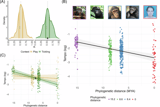
Human laughter retains a conserved rhythm but is faster, more variable, and governed by sophisticated context-dependent cognitive control that enables different social meanings and intents.
Rhythmic structure analyses showed significant isochrony peaks, with context-specific differences; tickling exhibited clearer isochrony than play across species.
The study and its reporting are supported by the Howard Hughes Medical Institute and the Robert Wood Johnson Foundation, with AP responsible for content.
Researchers recorded laughter from four orangutans, two gorillas, three bonobos, four chimpanzees, and four human children (ages 6 months to 7 years) in two settings: regular play and tickling.
The research was conducted at the University of Warwick and published in Communications Biology, with authors Chiara De Gregorio, Marina Davila-Ross, and Adriano R. Lameira.
Findings contribute to understanding how timing and vocal-cord modulation evolved and laid groundwork for the emergence of complex spoken language.
Ethical considerations note data collected from non-human primates across multiple institutions (2004–2006) and human infant recordings with parental consent, all procedures adhering to regulations.
Methodology included extensive tempo variability analysis, tk and rk measurements, and phylogenetically informed mixed models; data and scripts are publicly available on Zenodo.
The study reinforces a link between human and nonhuman primate communication while highlighting distinct evolutionary paths for speech and language.
Experts interpret the results as evidence of advanced vocal motor control in great apes and humans, informing the evolution of vocal flexibility in the primate lineage.
Key expert perspectives suggest laughter offers an evolutionary window into pre-speech vocal transformations, supporting a gradual continuum rather than abrupt change.
Summary based on 11 sources
Get a daily email with more Science stories
Sources
AP News • Jun 25, 2026
Humans and apes laugh in similar ways, study suggests | AP News
Yahoo News • Jun 25, 2026
Get a load of this: Humans and great apes share similar giggles
Neuroscience News • Jun 25, 2026
Great Ape Laughter Reveals Clues to Human Speech Origins