Revolutionary Nanoparticle Core Design Enhances Ice Recrystallization Inhibition, Transforming Cryopreservation and Anti-Icing Technologies
June 29, 2026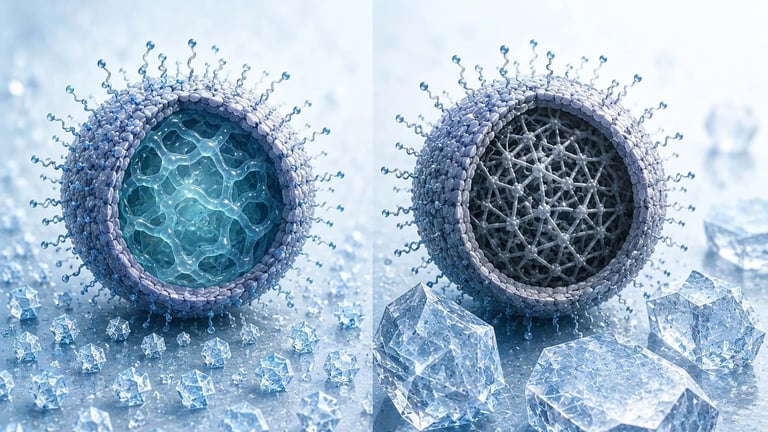

Implications for applications include potential benefits for cryopreservation of tissues, cells, and organs, improvements in frozen food texture, and the development of anti-icing coatings for infrastructure and vehicles.
Broader impact: this work prompts reevaluation of nanoparticle design in fields such as drug delivery, catalysis, and sensing where core-shell dynamics may be critical.
The study shows that the internal hydrophobic core of polymer nanoparticles, not just the corona, dominantly affects ice recrystallization inhibition (IRI) activity in PISA-derived particles.
Introductory: Scientists report that internal core structure of polymer nanoparticles, engineered via polymerization-induced self-assembly (PISA), can control ice recrystallisation, challenging the prior focus on surface chemistry alone.
Soft core polymers with low glass transition temperatures (like PBzA) show stronger IRI activity than hard, high-Tg cores (like PBzMA), indicating greater core mobility enhances IRI.
Industry relevance: PISA’s scalability points to practical translation in commercial and clinical settings, enabling cost-effective, tunable ice-management materials.
Crosslinking soft cores with ethylene glycol dimethacrylate (EGDMA) abolishes IRI despite modest Tg changes, underscoring that core dynamics are essential for inhibition.
Increasing core length and particle size generally strengthens IRI, suggesting interfacial presentation and aggregation contribute to activity.
Researchers varied corona chemistries (PMPC, PAMPS, PMETAC) and core blocks (PBzMA, DAAM, PBzA, PHEMA) to map how core composition, rigidity, and crosslinking affect IRI.
Core architecture and mobility matter: soft, flexible cores inhibit ice growth more effectively than rigid ones; cross-linking the core eliminates inhibition, highlighting internal dynamics' importance.
Diblock nanoparticles with various coronas outperform free polymers in IRI, with activity driven by core properties rather than corona alone.
The study uses RAFT-mediated aqueous PISA and a splat assay to quantify IRI as a percentage of ice grain size relative to a control.
Summary based on 2 sources
Get a daily email with more Science stories
Sources

BIOENGINEER.ORG • Jun 23, 2026
Scientists Unveil Innovative Method to Regulate Ice Formation with Polymer
AZoNano • Jun 29, 2026
Soft-Core Nanoparticles Point to Better Ice-Controlling Materials