Breakthrough Orbitronics: Copper-Cobalt Oxide Enables 100x Stronger Magnetic Memory Signals
July 3, 2026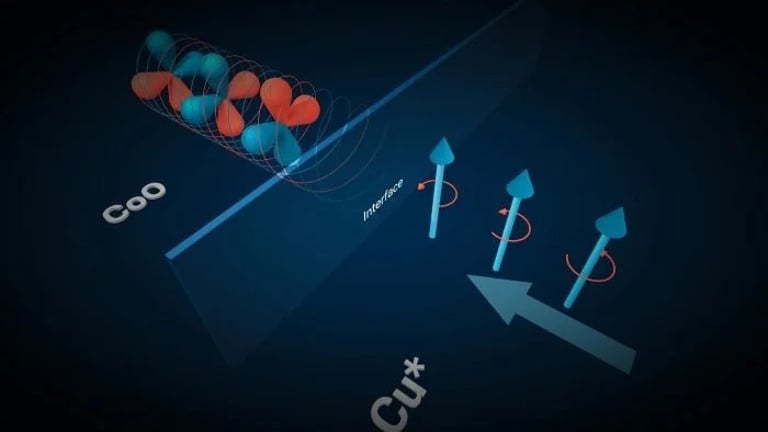

The team stresses that orbital-current operation is fundamentally different from spin-based approaches, potentially unlocking active degrees of freedom in antiferromagnetic materials for future devices.
Researchers at Johannes Gutenberg University Mainz demonstrated a direct, purely orbitronic device that uses orbital currents without converting them to spin currents, marking a milestone in orbitronics.
This work presents the first direct use of orbital currents without spin-current conversion, establishing a purely orbitronic device approach.
The direct coupling in an orbital-dominated magnet enables significantly more energy-efficient switching in magnetic memories, pointing to highly energy-efficient memory and computing technologies.
The orbitronic approach signals a fundamental difference in how orbital currents interact with antiferromagnets and actively enables orbital-based information processing.
This breakthrough builds on long-running, cross-continental collaboration among Germany, Japan, and EU-funded projects that combined material synthesis and theoretical work to achieve the result.
Led by Dr. Christin Schmitt with an international team, the work shows orbital currents can couple mobile and localized orbital moments in a magnet to yield signals two orders of magnitude stronger than traditional spintronic devices.
A new orbitronic effect in copper-cobalt oxide systems shows mobile orbital moments in copper can couple directly to localized orbital moments in cobalt oxide, enabling read/write of magnetic information with signals about 100 times stronger than conventional spintronic devices.
The findings were published in Science in 2026 under the title Orbital magnetoresistance in the antiferromagnet CoO driven by dynamic orbital angular momentum.
Compared with a cobalt oxide/platinum spintronic system, the orbitronic setup produced signals about 100 times stronger and activates hidden properties of the antiferromagnet rather than merely mimicking a spin current.
The international team of more than 20 researchers contributed, with samples provided by the University of Tokyo, and the study was published in Science.
A model system uses cobalt oxide as an insulating antiferromagnet with a copper layer that forms copper oxide at the surface, allowing orbital currents generated in copper to propagate toward cobalt oxide and couple with its orbital moments to encode data as 0s and 1s.
Summary based on 2 sources
Get a daily email with more Science stories
Sources
Phys.org • Jul 2, 2026
Orbitronics clears key hurdle with direct orbital currents, boosting signals 100-fold
AZoQuantum • Jul 3, 2026
Milestone Achieved in Orbitronics