Euclid Telescope Unveils 31 Ancient Quasars, Including Oldest Known, Challenging Black Hole Growth Models
July 8, 2026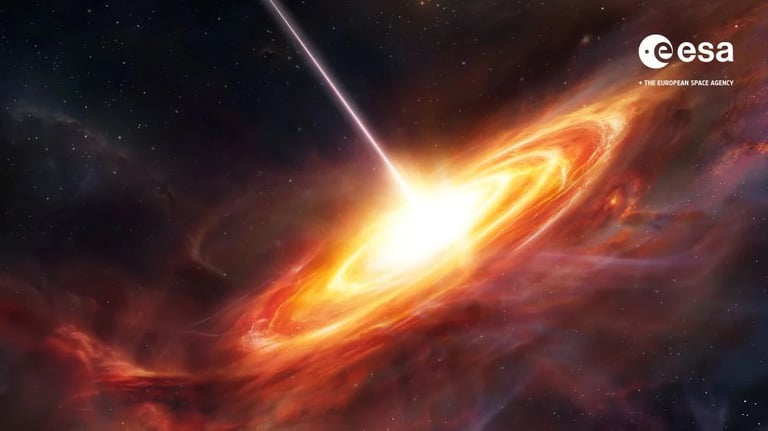

The Euclid space telescope has uncovered 31 new high-redshift quasars dating to about 13.4 billion years ago, including the most ancient known quasar at z = 7.7, greatly expanding the early-universe quasar population.
These discoveries come from the Euclid Wide Survey, which began in early 2024 and, over roughly two years, mapped about a third of the sky to reveal 31 ancient quasars.
The quasars originate from the epoch of reionization, offering insight into how the first galaxies and their central black holes formed as hydrogen transitioned from opaque to transparent.
Scientists suggest two possible explanations for the rapid early growth: either the first black holes started massive due to exotic origins, or they grew much faster than previously thought.
Researchers, including Eduardo Bañados and Joseph Hennawi, note that observing these early quasars helps explain how black holes reached hundreds of millions of solar masses in the universe’s first hundreds of millions of years.
The findings, published in Astronomy & Astrophysics, indicate we can study the typical early-universe quasar population, not just exceptional outliers, shedding light on the joint growth of supermassive black holes and their host galaxies.
Looking ahead, further backdating observations could deepen our understanding of the formation of the first galaxies and their central black holes.
The quasars illuminate the epoch of reionization, with at least a dozen quasars at z ≥ 7, more than doubling the known distant-quasar sample and enabling better studies of early galaxy formation and SMBH growth.
The discovery challenges existing models of black hole growth, given the young universe and limited time for enormous black holes to form.
The quasars are powered by accreting supermassive black holes with masses ranging from hundreds of millions to billions of solar masses, with the oldest objects emitting roughly a trillion times the Sun’s brightness.
The discoveries come from the epoch of reionization, a period marking the universe’s transition from opaque to transparent as hydrogen was ionized.
Lead author Daming Yang and colleagues show that massive quasars existed only about 670–670 million years after the Big Bang, implying massive dark matter halos and rapid SMBH growth in the early universe.
Summary based on 3 sources
Get a daily email with more Science stories
Sources
Yahoo News • Jul 8, 2026
Ancient quasars add to a 'major unsolved problem' in astrophysics
Scientific American • Jul 7, 2026
Astronomers discover some of the most extreme primordial quasars in the universe
Universe Today • Jul 7, 2026
The Euclid Space Telescope Has Found 31 New Ancient Quasars, Including the Most Ancient One Ever Found