New Horizons Reawakens: Preparing for Deep Space Data Transmission and Sun's Edge Study
July 8, 2026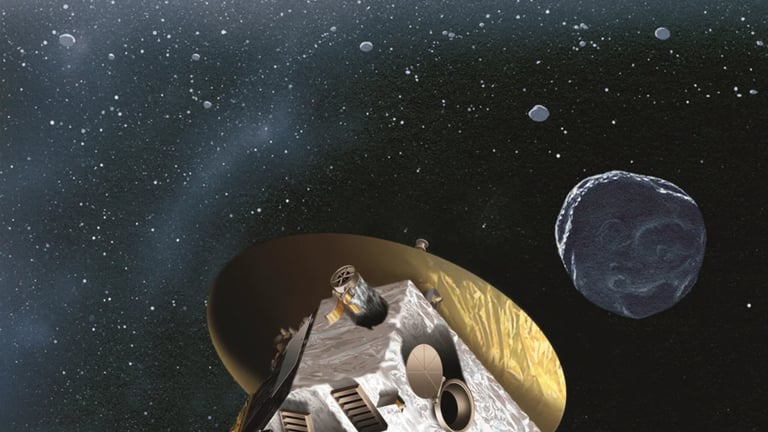

New Horizons has woken from its year-long hibernation roughly 9.5 billion kilometers from Earth, is in good health, and is resuming data collection with 321 days of accumulated observations ready to be transmitted.
The spacecraft is now downlinking the data gathered over the hibernation period and reporting its health as it resumes operations from deep space beyond Pluto.
The wake-up occurred on June 23, with confirmation that New Horizons is healthy and prepared to transmit Kuiper Belt data.
There are currently no target objects; the mission will focus on studying the Sun’s interaction with interstellar space rather than scouting for new celestial bodies.
A key scientific focus is the termination shock—the boundary where solar wind slows against interstellar space—and New Horizons’ advanced instruments will provide sensitive measurements at this region, previously explored mainly by Voyager probes.
Ground software upgrades and new autonomy logic are underway to enable operations farther from the Sun, with testing continuing through the year to counter reduced power and longer radio travel times.
These software enhancements aim to sustain autonomous operations amid declining RTG power and longer communication delays as the probe journeys outward.
During hibernation, core instruments like SWAP, PEPSSI, and the Venetia Burney Student Dust Counter continued monitoring the outer heliosphere and local dust while other systems were powered down.
The mission continues as a deep-space observatory studying the outer heliosphere and Kuiper Belt dust, moving away from the Sun at about 480 million kilometers per year.
As it travels outward, New Horizons will study hydrogen in the outer heliosphere near the solar wind boundary, the termination shock.
The current activation phase will transmit collected data to Earth and implement software updates to support future operations.
Upon resuming, health data will be downlinked first, followed by instrument observations, with the Alice ultraviolet spectrograph beginning hydrogen gas studies in a few weeks as other instruments continue measurements.
Summary based on 4 sources
Get a daily email with more Science stories
Sources
NASA Science • Jul 7, 2026
NASA’s New Horizons Spacecraft Wakes from Hibernation in Good Health - NASA Science
The Watchers • Jul 8, 2026
New Horizons awakens after longest hibernation, resumes science mission 9.5 billion km from Earth