AI Model 'RHINE' Revolutionizes Nuclear Reaction Estimates for Stellar Explosions
July 8, 2026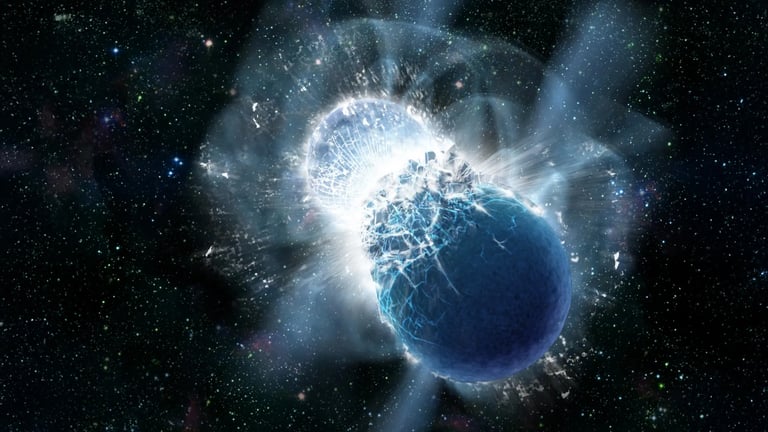

Accurate r-process heating is important for future modeling, and RHINE can make simulations more detailed and efficient.
The tool aims to strengthen the connection between future FAIR facility experiments and astronomical observations of stellar explosions and neutron star mergers.
Researchers, including Dr. Oliver Just and Dr. Zewei Xiong of the Nuclear Astrophysics & Structure department at GSI/FAIR, validated RHINE by comparing its outputs to reference data, showing strong agreement.
RHINE is expected to enable more complex future simulations and tighter integration between laboratory nuclear physics, stellar explosion modeling, and astronomical observations, particularly at the FAIR facility.
RHINE replaces exhaustive nuclear reaction calculations with a trained neural network that, after learning from a comprehensive library of reference calculations, estimates heating rates with significantly reduced computational cost.
An international team at GSI/FAIR developed RHINE, an AI-driven model to improve simulations of heavy element formation during r-process events in neutron star mergers and supernovae.
Training involves extensive reference calculations that include complete nuclear reaction networks, and the trained model is integrated into hydrodynamic simulations to approximate heating during the r-process.
RHINE’s source code has been released publicly to encourage collaboration, with funding support from the European Research Council (ERC) among others.
The model targets the r-process, where rapid neutron capture in violent stellar events builds up heavy atomic nuclei, influencing ejecta dynamics and kilonova light emission.
Validation shows a high degree of agreement between RHINE predictions and reference data, indicating substantial reductions in compute time while preserving accuracy.
The r-process involves rapid neutron capture by nuclei, followed by some neutrons converting to protons, enabling growth to heavy elements and influencing ejecta velocity and kilonova luminosity.
Summary based on 2 sources
Get a daily email with more Science stories
Sources
ScienceDaily • Jul 8, 2026
New AI model reveals how neutron star mergers forge heavy elements
SSBCrack News • Jul 8, 2026
AI-Driven Model Enhances Understanding of Heavy Element Formation in the Universe - SSBCrack News