Google's Quantum Leap: Reinforcement Learning Revolutionizes Real-Time Error Correction in Quantum Computing
July 11, 2026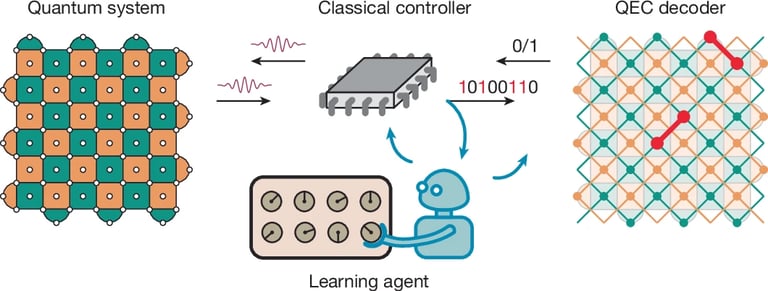


Willow, Google's quantum processor, now operates with continuous reinforcement learning control layers that unify real-time calibration and active quantum error correction to autonomously stabilize logical qubits during uninterrupted runs.
The architecture combines a hardware node running distance-5/7 surface codes and a distance-5 color code, using a factorized multivariate Gaussian policy across roughly 1,000 controls.
Details and validation are available in supplementary materials and a Nature publication released by July 2026.
Google has demonstrated a continuous recalibration approach for quantum processors by applying reinforcement learning to the error-correction data generated during computations, enabling real-time calibration and control.
The RL system calibrates and controls a large quantum error correction processor to counter drift and maintain low logical error rates throughout continuous operation.
The policy is modeled as a factorized multivariate Gaussian to meet data-rate constraints, with a time-varying mean tracking the optimal policy and a covariance guiding exploration to adapt to drift.
The RL framework uses a surrogate objective based on the average rate of error-detection events, enabling scalable optimization over high-dimensional controls while linking to LER gradients through a simple model.
Scaling analyses suggest the framework remains efficient as system size grows by leveraging local error-detection structure and keeping optimization localized to nearby events.
The research demonstrates potential for maintaining calibration during longer computations, though current hardware limitations mean it’s not yet practical for extended, complex runs.
Simulations indicate real-time steering can be effective for distance-3 and distance-15 codes, showing scalability with a drift-frequency threshold that allows steering below about one over 150 epochs.
Looking ahead, the work points to extending to deep neural networks for conditioning policies on observations and learning system models to improve sample efficiency, with a goal of fully RL-driven QEC calibration.
Experiments on distance-5/7 surface codes and a distance-5 color code show RL can manage over 1,000 control parameters and improve logical error rate stability by about 2.4×, up to 3.5× with decoder steering.
Summary based on 4 sources
Get a daily email with more Tech stories
Sources
Ars Technica • Jul 10, 2026
Quantum error correction can constantly recalibrate a processor
Nature • Jul 8, 2026
Reinforcement learning control of quantum error correction
VP Insights: Global Tech Trends and Insights • Jul 10, 2026
Autonomous Quantum Computer Calibration