New Breast Cancer Framework Predicts Immunotherapy Responses with Three CIC Subtypes
July 12, 2026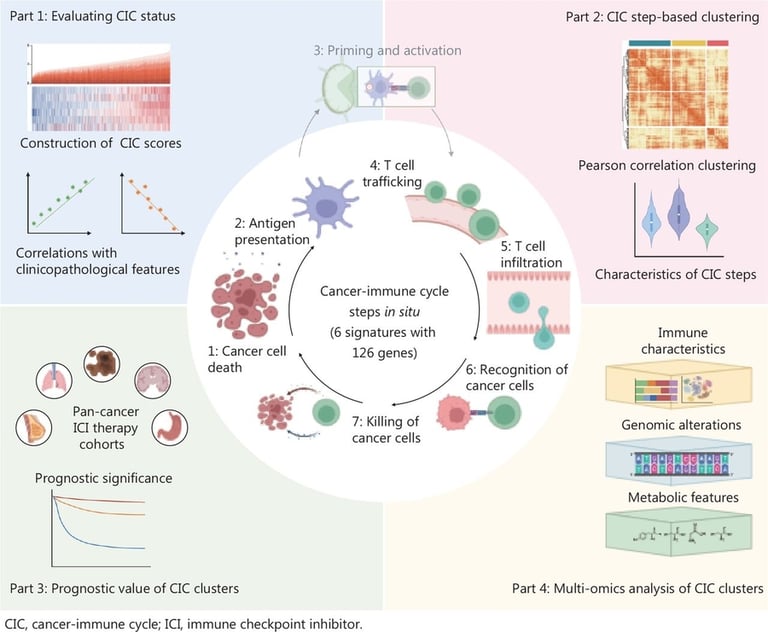

A new breast cancer framework assesses the cancer-immunity cycle (CIC) across six steps, grouping tumors into three CIC subtypes: C1 (immune-cold), C2 (immune intermediate with antigen-presentation defects), and C3 (immune-hot), with C3 showing the best response to immune checkpoint inhibitors.
The CIC score quantifies activity through the six steps and reveals distinct immune-evasion mechanisms across the patient clusters.
Researchers identify three breast cancer subtypes by analyzing the CIC, with C1 characterized by low immune signals, C2 by antigen-presentation defects, and C3 by high immune activity.
Funding support for the research came from China’s National Key Research and Development Program (Grant 2020YFA0112304) and the National Natural Science Foundation of China (Grants 82441028, 82202883, 82573645).
Multi-omics reveal metabolic dependencies tied to each CIC cluster: C1 is enriched for sphingolipid metabolism, C2 relies on serine metabolism, and PSAT1 acts as a key regulator in C2, where its knockdown lowers PD-L1 and TGFB1 expression.
The CIC framework moves beyond a binary hot/cold view to predict who benefits from immune checkpoint inhibitors and to guide tailored combination therapies for each cycle defect.
C1 tumors show low immune infiltration with immunosuppressive M2 macrophages, C3 tumors have robust immune activity and the best ICI responses, while C2 tumors exhibit high mutational burden but HLA loss and an immunosuppressive environment, impairing antigen presentation.
The study appears in Cancer Biology & Medicine in 2026 (DOI: 10.20892/j.issn.2095-3941.2025.0611), conducted by researchers at Fudan University Shanghai Cancer Center and Shanghai Medical College.
Clinically, the CIC score could stratify patients for ICI therapy and guide cluster-specific treatments, such as converting C1 from immune-cold to immune-hot or targeting PSAT1/HLA pathways in C2 to enhance antigen presentation and immune activation.
Overall, this framework classifies breast cancer by the cancer-immunity cycle to predict immunotherapy responses and identify targets for combination therapies.
Summary based on 2 sources
Get a daily email with more Science stories
Sources

24-7 Press Release Newswire • Jul 12, 2026
Decoding the cancer-immunity cycle: A New roadmap for breast cancer immunotherapy