EEG Study Reveals Brain Resets Context During Attention Shifts in Competing Speech Streams
July 18, 2026

In a dynamic multi-talker setting, the study examines how brain representations of competing speech streams evolve as listeners switch attention, using EEG in normal-hearing adults.
Participants were cued to switch attention between two TED-talk style streams amid background babble, with switches roughly every 15 to 30 seconds, and neural decoding reliably tracked the attended stream across different decoding windows.
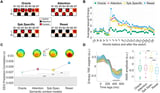
The researchers test how lexical context is updated after a switch by comparing four context-accumulation strategies drawn from large language models, using TRF models to evaluate whether context is maintained, reset, or selectively updated.
Neural metrics include TRF-based tracking of both speech streams, alpha-band ERSP changes around switches, and model-based measures of lexical surprisal and entropy to assess context-update hypotheses.
Data and materials, including EEG datasets and analysis code, are openly available on Zenodo to support transparency and reproducibility.
Findings support a model where listeners may reset lexical context after switching attention, highlighting both timing dynamics and contextual mechanisms in flexible speech processing.
Encoding analyses reveal that engagement with a new target stream emerges before disengagement from the previous one, suggesting transient simultaneous encoding of both streams.
Context and methods section situates the study within a broader field that includes AI-based hearing aids and perceptual phenomena in auditory attention research.
A decrease in EEG alpha power accompanies attention switches and tracks the cognitive effort involved in the switching phases.
The alpha reduction during switching aligned with increased mental effort as listeners transition between streams.
Large language models are used to model how listeners reconstruct the conversational thread, with evidence that the brain resets context each time attention shifts to a new voice.
During EEG recording of a two-talker mix with babble, listeners received cues to shift focus every 15 to 30 seconds, enabling analysis of neural attention switching.
Summary based on 2 sources
Get a daily email with more Science stories
Sources
PLOS Biology • Jul 16, 2026
Competing speech streams are simultaneously represented in the human cortex during attention switching
Boing Boing • Jul 17, 2026
Your brain can track two voices at the same time