First Binary Supernova Remnants Discovered in Jellyfish Nebula, Confirmed by Gamma-Ray and Multiwavelength Data
July 21, 2026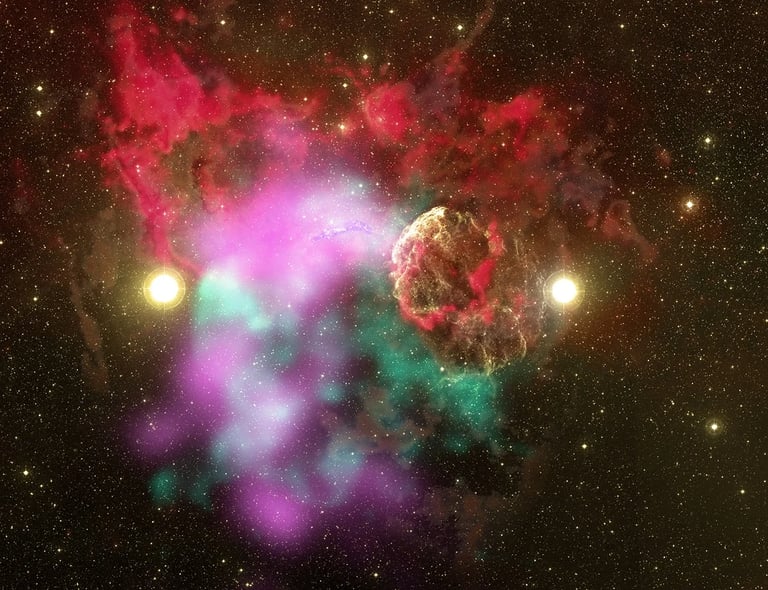

Evidence suggests two massive stars in a binary exploded as supernovas within a relatively short interval, leaving behind two glowing nebulae in the Milky Way.
Nature Communications reports evidence that IC 443 and G189.6+3.3 originated from stars once in a binary, with gamma-ray emissions and spectral analysis showing distinct regions of G189.6+3.3 from different high-energy particle populations.
Odds of a chance alignment were calculated at about one in a thousand, making a binary origin more plausible than a random alignment.
The study focuses on IC 443 and nearby remnant G189.6+3.3, suggesting they were in the same interstellar cloud and exploded 30 to 50 light-years apart.
Using 16 years of Fermi-LAT data plus X-ray and multiwavelength observations, researchers identify G189.6+3.3 as a second, hidden remnant of a binary system with IC 443.
A landmark discovery would emerge if confirmed: the first observed pair of supernova remnants arising from a stellar binary, offering new constraints on late-stage massive binary evolution, including timing between explosions and binary survivability after supernova events.
Scientists report the first possible binary system where both stars exploded as supernovas, supported by analysis of two nearby remnants.
IC 443, the Jellyfish Nebula in Gemini about 6,000 light-years away, sits in a complex environment that has historically made separating sources challenging.
Estimated ages place G189.6+3.3 at roughly 20,000 to 110,000 years old and IC 443 at about 8,000 to 9,000 years, with the original stars likely 20 or more solar masses.
This rare binary supernova remnant system in the Jellyfish Nebula and its neighbor G189.6+3.3 was revealed through sensitive gamma-ray observations and extensive data analysis.
Long-term data from NASA’s Fermi Gamma-ray Space Telescope, along with X-ray, optical, and radio observations, indicate both remnants likely originated from a common binary pairing rather than independent events.
A complex gamma-ray glow traces the X-ray shell of G189.6+3.3, confirming it as a second supernova remnant previously hidden by IC 443’s brightness.
Summary based on 4 sources
Get a daily email with more Science stories
Sources
Gizmodo • Jul 21, 2026
Astronomers May Have Found the First Pair of Stars to Explode Together
Yahoo News • Jul 21, 2026
Scientists spot evidence of two huge companion stars that blew up
Space • Jul 21, 2026
Scientists may have found the 1st twin star system where both stars exploded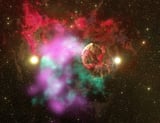
Scientific American • Jul 21, 2026
Rare double supernova discovered hiding in Jellyfish Nebula