Queen Bee Pheromone Discovery Reveals Secrets of Insect Society Cooperation and Evolution
July 29, 2026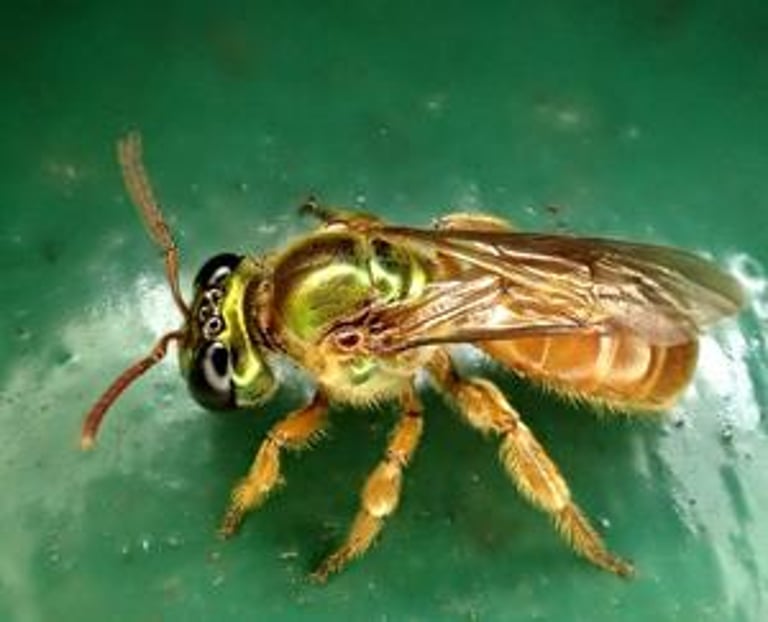

The study links higher levels of queen-produced methylalkanes to greater reproductive output by the queen and more daughters choosing to stay and help, indicating an honest signal of royal fitness.
Researchers identify methylalkanes as the queen pheromones that signal reproductive capability and influence daughters’ roles within the colony.
Leading researchers include Callum Kingwell of Princeton STRI and Bill Wcislo, with results published on July 28 in Proceedings of the Royal Society B.
Chemical analyses were conducted in the field using gas chromatography–mass spectrometry to identify and quantify pheromonal compounds on live bees throughout their lifespans.
Experts describe the study as providing a complete story of chemical signaling, behavior, and evolutionary implications.
Field work focused on Megalopta genalis on Barro Colorado Island, Panama, using artificial nests and long-term observation to track daughters’ fates and analyze pheromonal signals.
The Panama study leveraged Barro Colorado Island’s long-term field observations and live-behavior sampling to study chemical signaling in free-living bees.
Researchers from the Smithsonian Tropical Research Institute and Princeton University conducted a multi-year study on Barro Colorado Island, deploying artificial nests and recording bee behavior.
Findings are interpreted as evidence that queen pheromones contribute to cooperative behavior and could stabilize nascent insect societies, marking the first identified queen pheromone in a flexible social insect.
The work offers insights into the evolution of cooperation in insect societies and broader implications for evolutionary biology and animal behavior.
The findings illuminate how nascent insect societies might stabilize and evolve toward greater social complexity, advancing understanding of queen pheromones in flexible social insects.
Pheromone production depends on a dietary protein essential for reproduction, making it costly for the queen to falsely advertise royal status.
Summary based on 3 sources
Get a daily email with more Science stories
Sources
EurekAlert! • Jul 28, 2026
Queen bee pheromones help daughters decide whether to stay or leave the nest
Smithsonian Magazine • Jul 28, 2026
In This Bee Species, Why Do Some Daughters Leave Home While Others Stay 'Bee-hind' to Help Mom?
Smithsonian Institution • Jul 28, 2026
Queen Bee Pheromones Help Daughters Decide Whether to Stay or Leave the Nest