New Solar Telescope Reveals Stunning Whirlpool Patterns on Sun's Surface
August 5, 2026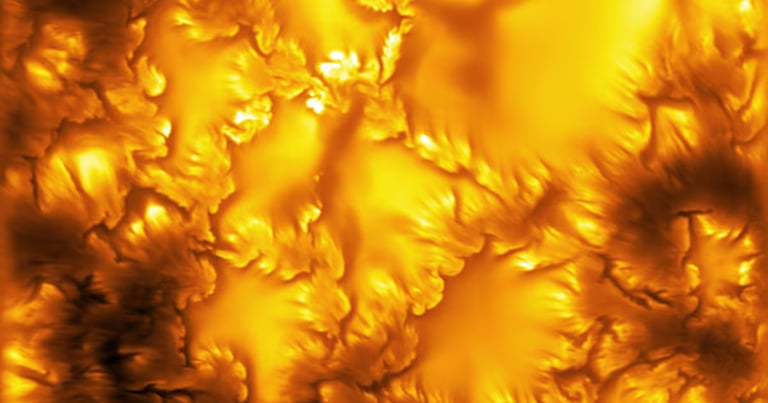

Scientists using the Daniel K. Inouye Solar Telescope in Maui captured the Sun’s surface in unprecedented detail, revealing a highly dynamic realm with new feathery rippling patterns.
The high-resolution imagery reveals Kelvin-Helmholtz instabilities—whirlpool-like vortices formed when fast-moving plasma shears past slower flows—unveiling spiralling structures on the solar surface.
These observations test the telescope’s capabilities, showing vivid, magnetized plasma moving at different speeds and producing water-like surface waves on the Sun’s bright outer shell.
Researchers say understanding these small-scale processes is essential for predicting disruptive solar activity in the future.
Context links these surface dynamics to potential connections with solar storms and auroras, underscoring relevance to space weather monitoring.
The study proposes that surface motions may connect to large-scale solar eruptions, contributing to improved space weather forecasting.
Experts emphasize that confirming KHIs on the Sun validates new avenues in solar physics and highlights the significance of the finding.
Access to the full article is restricted to subscribers, with a note that a large portion remains unread without login or subscription.
The researchers suggest energy cascades from large instabilities to smaller scales dissipate as heat, potentially contributing to coronal heating.
Continued observation of magnetic structures and their fluid-like motions is crucial for building a comprehensive picture of solar activity and its Earth impacts.
Plans exist to use automated analysis to identify KHIs across more data, assessing their prevalence and impact on the corona and lower solar atmosphere.
The discovery enhances understanding of the solar photosphere and supports theories about magnetic flux braiding relating to coronal heating and flare activity.
Summary based on 18 sources
Get a daily email with more Science stories
Sources
AP News • Aug 5, 2026
Scientists photograph the sun's surface in the finest detail yet | AP News
Gizmodo • Aug 5, 2026
The Sun Looks So Hot Right Now
Yahoo News • Aug 5, 2026
New images of the sun show its surface in the finest detail yet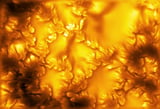
Yahoo News • Aug 5, 2026
Swirling, vortex-like patterns observed on the sun's surface