Zebra Mussels Invade Great Lakes: $1.5 Billion Ecosystem Disruption
August 9, 2026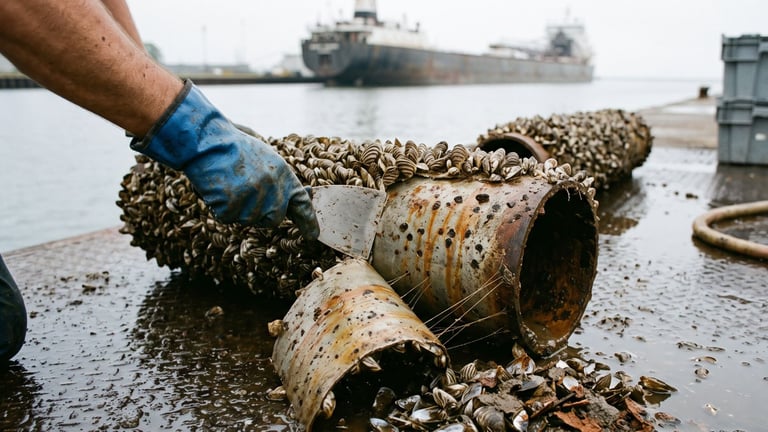

The zebra mussel was introduced to the Great Lakes in the late 1980s through ballast water discharged from ships, spreading rapidly to 23 states and two Canadian provinces within about 15 years.
The invasion disrupted ecosystems by clarifying water and reducing plankton, shifting algae distribution, destabilizing food webs, and impacting species like whitefish, while also driving economic costs from clogged intake pipes and related infrastructure estimated at $1 to $1.5 billion.
International shipping controls and ballast water treatment have been adopted to curb future introductions, but these measures do not resolve established populations.
Lake Superior largely resisted invasion due to its low calcium levels, around 12 mg/L, which prevent shell formation, while Lakes Erie, Ontario, Michigan, and Huron were heavily affected.
Since the initial invasion, the mussel population has shifted in deeper waters toward the quagga mussel, which tolerates colder, soft-mud environments, while zebra mussels remain dominant in shallower areas.
A single female mussel can release up to a million eggs in a season, and larvae can drift for weeks, enabling rapid natural and overland spread via boats and trailers.
Summary based on 1 source