Programmable DNA Origami Nanosyringe Revolutionizes Biochemical Process Control in Synthetic Cells
August 11, 2026

A Nature Nanotechnology study unveils a fuel-driven DNA origami nanosyringe that can reversibly breach membranes and deliver cargo across model lipid membranes.
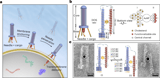
The device, a double 14-helix DNA origami bundle, is connected by a gold nanoparticle and features a base, a needle with central channels for cargo transport, and seven cargo-conjugation sites at the tip.
Inspired by bacterial contractile injection systems, it uses DNA strand displacement to generate controlled mechanical motion at lipid interfaces for targeted delivery.
A hexagonal-lattice variant that occludes the central channels renders the device nearly impermeable, confirming central channels as the primary transport route with minimal disruption to the membrane.
Future work aims to broaden cargo range through new tethering chemistries, enhance cell targeting and therapeutic delivery, and extend the platform to synthetic biology and nanomedicine.
The nanosyringe provides a platform for programmable, membrane-associated biochemical reactions within synthetic cells, with potential applications in diagnostics, therapeutics, and synthetic biology.
Membrane penetration proceeds in ~14 nm sliding steps, achieving up to 28 nm displacement and forming a stable conductive pore, as shown by electrophysiology with a linear current–voltage relationship.
DOS-driven RNA transcription is demonstrated by releasing Spinach aptamer transcripts into GUV interiors after penetration, enabling visualization of transcription inside synthetic compartments.
10–23 DNAzymes are delivered across the membrane to cleave target RNA inside GUVs, with fluorescence confirming catalytic activity.
Fuel-actuated membrane breaching enables programmable, dynamic cargo release, suggesting control over cellular-like processes in synthetic biology contexts.
The system is reversible: needle retraction restores membrane integrity, and FRAP and current measurements confirm resealing after actuation.
The work situates itself in a broader field of programmable nanodevices for biochemical regulation, citing related studies and reviews to contextualize progress.
Summary based on 5 sources
Get a daily email with more Science stories
Sources
Nature • Aug 11, 2026
A programmable DNA origami nanosyringe for directed membrane translocation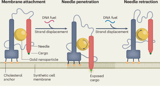
EurekAlert! • Aug 11, 2026
Programming membrane transport
BIOENGINEER.ORG • Aug 12, 2026
Scientists Engineer Cellular Membrane Transport