Gluons, Not Quarks, May Carry Baryon Number: New Study Challenges Traditional Physics
August 13, 2026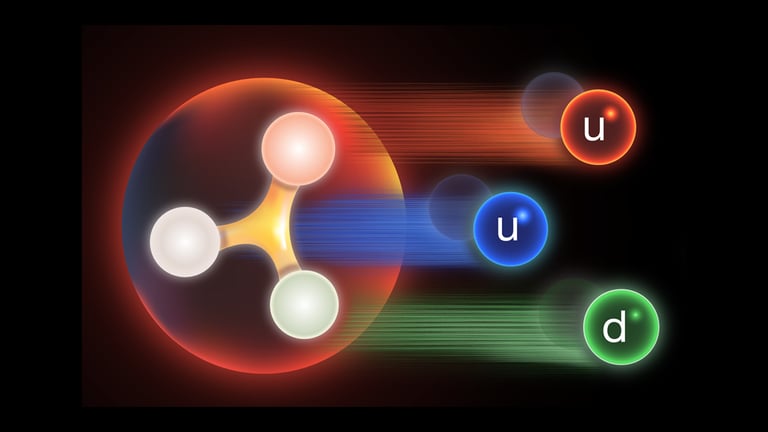

A new study from the STAR detector at RHIC provides strong evidence that gluons carry baryon number via a Y-shaped gluon junction, challenging the traditional view that baryon number resides solely in the three valence quarks.
Published in Science, the study presents robust experimental results that oppose the simple valence-quark picture and support the baryon junction as the carrier of baryon number.
Researchers analyzed high-energy collisions at RHIC using isobar collisions of ruthenium-96 and zirconium-96 and photonuclear collisions to compare baryon transport with electric charge transport.
The work has broad implications for understanding baryon number conservation from collider scales to the early universe and touches on the matter–antimatter asymmetry problem.
In isobar collisions, baryons appear to travel farther than electric charge through the dense collision zone, consistent with a zero-electric-charge baryon junction carrying baryon number.
Some scientists caution that the junction picture and the valence-quark picture may be complementary rather than mutually exclusive, since the junction concept is tied to quarks.
While measurements disfavor the pure valence-quark picture, they do not identically isolate the mechanism; further investigation is needed to fully understand baryon number transport and its implications for matter–antimatter balance.
In proton structure, baryon number is defined as 1 for baryons and 0 for mesons and is conserved in reactions, with baryons composed of three quarks plus gluons.
The research suggests the baryon number of protons may reside in gluons, specifically in a Y-shaped gluon structure called a baryon junction.
These findings fit into a broader effort to understand the strong force and matter stability, with future experiments like the Electron-Ion Collider expected to continue probing these questions.
The study was funded by the U.S. Department of Energy, the National Science Foundation, and international partners, and used computing resources from Open Science Grid, Brookhaven’s Scientific Computing and Data Facilities, and NERSC.
Photonuclear collisions, where photons carry no baryon number, provide a clean testbed; results align with Regge theory and favor the junction model over valence-quark transport.
Summary based on 3 sources
Get a daily email with more Science stories
Sources
Rice News | News and Media Relations | Rice University • Aug 13, 2026
Scientists uncover new clue to how protons maintain their identity
ScienceAlert • Aug 13, 2026
After 50 Years, Physicists Find Strong Evidence For What Really Holds Matter Together
Science News • Aug 13, 2026
The glue that binds a proton may be key to its identity