Ancient Galactic Merger Rewrites Milky Way's History: Hubble Reveals 11.8 Billion-Year-Old Collision
August 17, 2026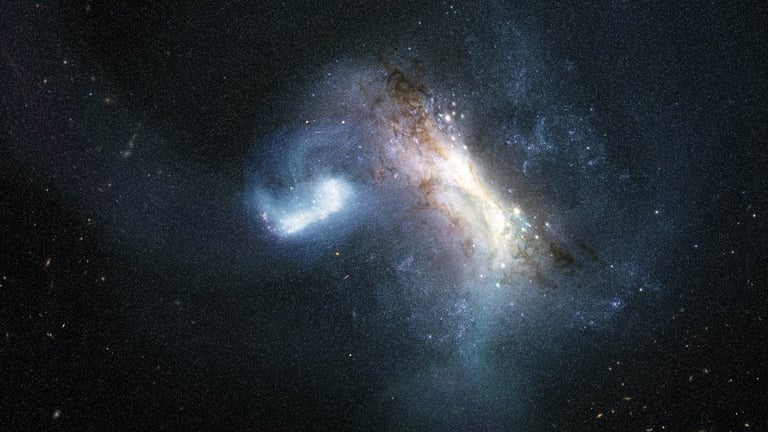

A long-ago merger, nicknamed Low-energy-Kraken-Heracles (LKH), seeded the Milky Way with stars, gas, and dark matter, influencing the formation of the solar system and Earth and illuminating our origins.
The merger occurred roughly two billion years after the Big Bang, with stellar remnants likely still in the Milky Way’s inner regions, though dust makes individual stars hard to identify.
Massari and colleagues describe the merger as peaceful for stars but potentially explosive for gas, triggering intense star formation as LKH gas mixed with Milky Way gas.
Globular clusters from LKH are older than Milky Way-born clusters but younger than those from Gaia-Sausage-Enceladus, indicating an external origin for those clusters.
The swallowed dwarf galaxy is nicknamed Low-energy-Kraken-Heracles (LKH) in reference to three research papers.
The Nature Astronomy article formalizes these findings and highlights Hubble’s continued scientific impact despite age-related challenges.
Gaia data mapping stellar motions complemented Hubble’s observations, though retracing distant history becomes less precise the further back one looks.
Researchers hope future space telescope missions will probe deeper into the galactic core, seeking more evidence, with ongoing work to study globular clusters.
Using data from Hubble and Gaia, scientists analyzed globular clusters within the inner 20,000 light-years to identify the LKH-origin population through ages, metallicities, and trajectories.
Forty-nine globular clusters were examined to reveal a third population, pointing to a separate collision with a galaxy of roughly 500 million solar masses.
High-resolution Hubble imaging and Gaia data enabled distinguishing LKH-origin clusters, helping reconstruct the Milky Way’s ancient merger history.
Looking ahead, predictions of a future encounter with Andromeda around 4.5 billion years from now remain uncertain.
Summary based on 7 sources
Get a daily email with more Science stories
Sources
Mashable • Aug 18, 2026
The Milky Way's center holds the ruins of another ancient galaxy
Yahoo News • Aug 18, 2026
The Milky Way devoured a smaller galaxy about 11.8 billion years ago
NASA Science • Aug 17, 2026
Hubble Solves Merger Mystery From Milky Way’s Early Years - NASA Science