Ancient Galactic Merger Rewrites Milky Way's History: Hubble Reveals 11.8 Billion-Year-Old Collision
August 17, 2026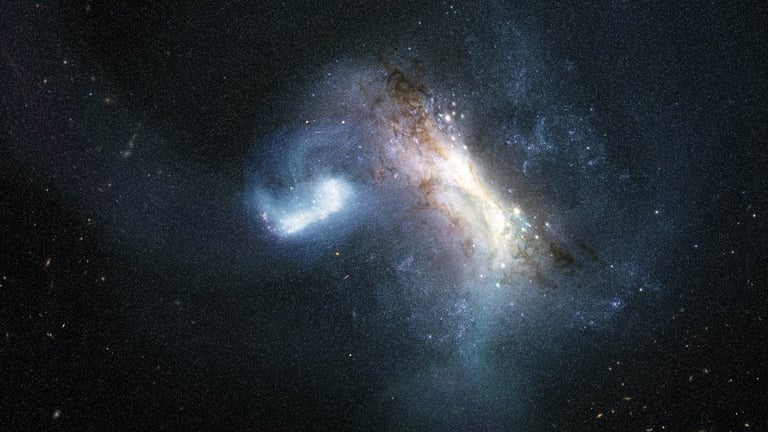

Lead author Davide Massari emphasizes that studying star clusters helps trace the origins of the Milky Way’s building blocks and shows external galaxies played a role in its early history.
The Milky Way’s earliest major merger occurred about 11.8 billion years ago when it absorbed a smaller dwarf galaxy, named Low-energy-Kraken-Heracles (LKH), bringing in stars, gas, dark matter, and reshaping the inner Milky Way.
Most of LKH’s material, estimated at roughly 500 million solar masses, was deposited into the inner 20,000 light-years of the Milky Way, significantly contributing to its mass and structure.
Hubble observations provide clear evidence of this ancient collision, aligning with simulations and supporting a merger timeline that predates other major events in the Galaxy’s history.
Future work will continue analyzing globular clusters with Hubble data to catalog and characterize all major mergers in the Milky Way’s past, potentially uncovering even older events.
Advanced computer simulations reinforce the merger timeline and chemical patterns seen in Hubble data, strengthening the case for LKH as the first major external event in the Galaxy’s formation.
Gaia’s mapping of stellar motions complements Hubble’s findings, though retracing very distant history remains increasingly uncertain the further back one looks.
The discovery supports a narrative in which mergers significantly shaped the Milky Way’s evolution, indicating external origins influenced early bulge and disk formation.
Context connects this event to prior discoveries and underscores the broader significance of galactic mergers in building our Galaxy.
The Nature Astronomy article formalizes these results and highlights Hubble’s ongoing scientific impact despite observational challenges related to the system’s age.
A detailed study of 39 globular clusters in the Milky Way’s inner region determined their ages, metallicities, and orbital properties, revealing a distinct LKH-origin population.
This 39-cluster analysis identifies a third population, indicative of a separate collision with a galaxy of roughly 500 million solar masses, linked to LKH.
Summary based on 4 sources
Get a daily email with more Science stories
Sources
Mashable • Aug 18, 2026
The Milky Way's center holds the ruins of another ancient galaxy
Yahoo News • Aug 18, 2026
The Milky Way devoured a smaller galaxy about 11.8 billion years ago
NASA Science • Aug 17, 2026
Hubble Solves Merger Mystery From Milky Way’s Early Years - NASA Science