3D Imaging Unveils Narwhal Tusk's Unique Double-Helix Structure, Offering Insights for Bioinspired Materials
August 18, 2026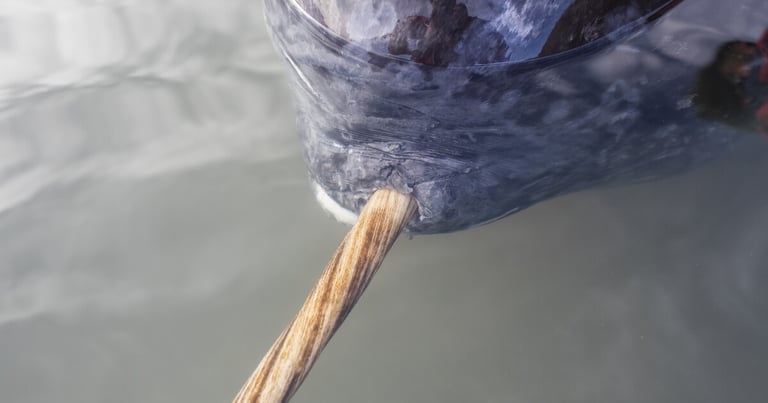

Researchers published findings in Nature Communications revealing that the narwhal tusk’s microstructure comprises two opposing spirals: an outer left-tilting cementum spiral and an inner right-tilting dentin spiral, which together help keep the tusk straight as it grows.
Narwhal tusks are long upper-canine teeth in males, with lengths reaching up to about seven feet.
The study used advanced imaging methods—X-ray computed tomography, scanning X-ray diffraction, scanning small-angle X-ray scattering, tensor tomography, and birefringence microscopy—on two male tusk and skull specimens across synchrotron facilities in Sweden, Switzerland, and France.
Researchers suggest future work should include more off-season studies and closer collaboration with Inuit communities to incorporate traditional knowledge about tusk flexibility and bending.
Interpretation relied on an interdisciplinary collaboration spanning chemistry, physics, materials science, and biology, including involvement from the Greenland Institute of Natural Resources.
If successful, tusk analysis could provide indirect insights into narwhal life history and Arctic conditions, given the challenges of observing these animals in their deep Arctic habitat.
Tusk samples were collected from Greenlandic Inuit hunters and the Greenland Institute of Natural Resources, underscoring international collaboration.
Observations suggest the tusk may aid in hunting large fish, though females can prey without it, indicating multifunctionality rather than a single purpose.
Experts note the discovery advances understanding of tusk formation and possible functions, including sensory roles or mating displays, while some caution that initial function labeling remains speculative.
Commentary from a Harvard-trained narwhal biologist acknowledged the study’s depth but urged cautious interpretation of functional claims.
The tusk is believed to have evolved largely through sexual selection, though its primary purpose remains under discussion.
Findings have broader implications for natural material construction and could inspire new composite materials for construction and medicine.
Summary based on 12 sources
Get a daily email with more Science stories
Sources

Ars Technica • Aug 18, 2026
X-rays add new twist to narwhal's spiral tusk
Yahoo News • Aug 18, 2026
What makes a narwhal’s tusk so special? Scientists are close to unraveling the mystery
New Atlas • Aug 18, 2026
The extraordinary engineering that builds nature's only straight tusk