New Study Reinforces Newtonian Gravity, Challenges Alternative Theories on Cosmic Scales
August 25, 2026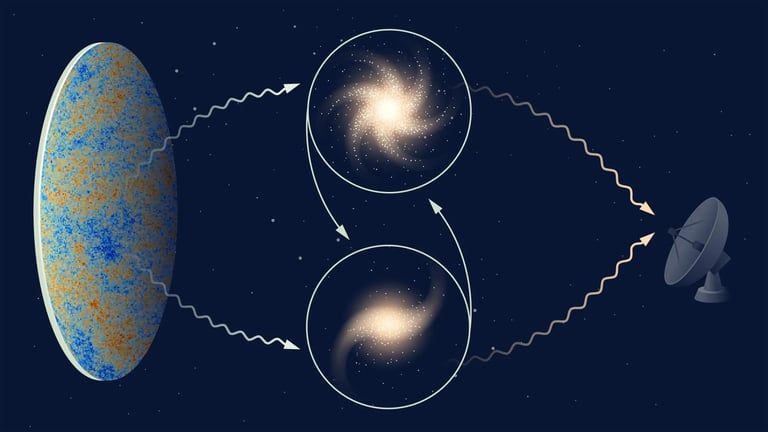

A new study tests Newtonian gravity on cosmic scales by using observations from the Atacama Cosmology Telescope to examine gravity across galaxy clusters separated by hundreds of millions of light-years.
The results show gravity declines with distance in a manner consistent with Newton's inverse-square law and general relativity, even on the largest scales observed, supporting standard gravity over modified theories like MOND.
The analysis finds gravity strength decreases with distance in galaxy clusters in a way that aligns with the inverse-square law, reinforcing the universality of gravity across vast cosmic distances.
Despite supporting dark matter, the precise nature and composition of dark matter remain unknown, leaving questions for future measurements of the CMB and larger galaxy surveys.
The findings strengthen the case for dark matter as the source of additional gravitational pull in galaxies and clusters, since altering gravity does not explain the observed motions.
Key collaborators include Patricio A. Gallardo and the ACT collaboration; the study is published in Physical Review Letters and involves more than 40 researchers from multiple institutions.
The findings contribute to contemporary cosmology by aligning observations with existing gravity theories and reducing the viability of alternative gravity modifications as explanations for anomalous motions.
This work narrows the space for alternative gravity theories and adds to the evidence for dark matter, while leaving open the exact nature of dark matter and prompting future, more precise measurements with larger surveys.
The results challenge modified gravity theories like MOND, predicting a steeper decline in gravity that is not observed, thus narrowing alternative explanations for cosmic dynamics.
The researchers analyze the cosmic microwave background as it passes through many galaxy clusters to measure gravitational effects, using tiny changes in CMB light to infer cluster motions and gravity strength.
By examining the CMB through massive clusters, the team infers gravitational effects on some of the universe’s largest structures to test gravity models.
Historically, the work extends Newton’s inverse-square law from the Solar System to scales unimaginable in his era, reinforcing gravity’s universality across cosmic distances.
Summary based on 2 sources
Get a daily email with more Science stories
Sources
ScienceDaily • Aug 24, 2026
Newton’s 300-year-old law just passed its biggest test yet
SSBCrack News • Aug 25, 2026
Gravity Laws Hold Up in Largest Test Yet, Supporting Dark Matter Theory - SSBCrack News