Microbial Synergy Unlocks Fucoidan Degradation, Advancing Marine Carbon Cycling Understanding
August 26, 2026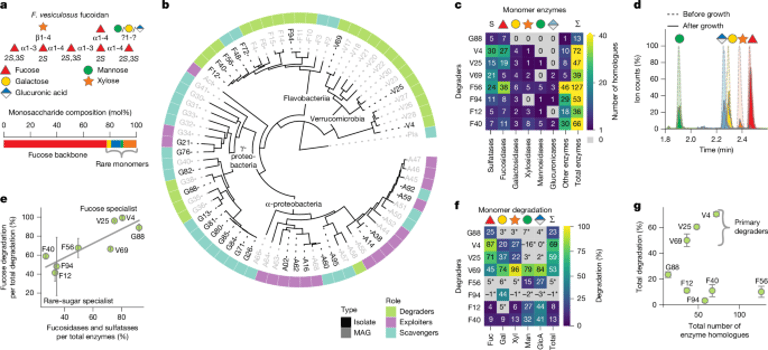

The study investigates how multiple microbial degraders coexist and synergize to break down fucoidan, a complex brown-algal polysaccharide that plays a key role in marine carbon export and sequestration.
Researchers characterized nine exo-acting enzymes targeting rare-sugar monomers, revealing distinct substrate specificities and how enzymatic complementarity expands the accessible substrate space.
A mechanistic model links community composition to degradation outcomes through a two-monomer (fucose and rare-sugar) framework, accurately predicting fucoidan degradation across 127 seven-strain combinations (R2 = 0.96).
Monomer-level assays show that individual degraders rarely achieve complete turnover of any monomer type, and full fucoidan degradation requires complementary metabolic activities.
Genomic analysis identifies 34 fucoidan-related PULs with diverse enzyme repertoires, with degradation capacity varying by strain and by fucose- versus rare-sugar specialization.
Pairwise cocultures reveal interaction types, including synergistic enhancements in degradation that exceed additive expectations, particularly among degraders.
Synergism tends to align with complementary monomer-degradation capabilities and with a genomic balance of sulfate- and fucose-targeting enzymes; dissimilarity in monomer degradation profiles shows a strong negative relationship with synergism.
Coastal seawater enrichments yielded 73 MAGs, dominated by Verrucomicrobiota, identifying key degraders, exploiters, and scavengers; a 29-isolate strain collection was built to study interactions.
Cell-free fucoidan degradation assays indicate that synergism arises from complementary enzymatic activities enabling access to bound carbon, not merely from cross-feeding.
Fucoidan’s sulfated fucose backbone and diverse side chains contain rare-sugar monomers, defining a division of labor into degraders, exploiters, and scavengers.
Validation across eight fucoidan types supports the generality of findings and robust prediction of community degradation from constituent strain capabilities.
The work provides a quantitative framework for understanding microbial cooperation in complex polysaccharide degradation and its implications for carbon cycling and the design of synthetic microbial consortia.
Summary based on 1 source
Get a daily email with more Science stories
Source
Nature • Aug 26, 2026
Synergistic degradation of fucoidans in the ocean