Transient Glycan Interactions: A New Frontier in Cell Signaling and Cancer Therapy
August 27, 2026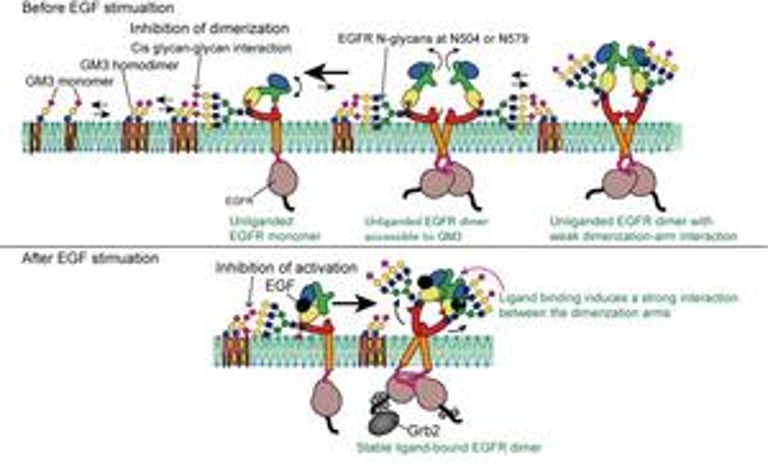

A team from OIST and partner institutions found that complex sugar chains called glycans on gangliosides and many membrane proteins form frequent, short-lived homodimer pairs in the plasma membrane, shaping membrane organization and signaling.
Using single-molecule imaging, researchers observed cis-glycan interactions—transient contacts between glycans on the same cell—that create membrane nanodomains and modulate signaling pathways.
The study reveals that glycans on gangliosides and numerous membrane proteins frequently form brief homodimers, influencing cell signaling and growth regulation.
A central finding centers on GM3 ganglioside, which suppresses EGFR dimerization only when it forms homodimers, with the paired glycans binding to corresponding EGFR glycans to renew a brake on EGFR activity when stimulation is absent.
GM3 gangliosides were observed forming relatively long-lived homodimers that assemble into rafts associating with EGFR, where GM3-glycan interactions dampen EGFR dimerization and activation.
GM3 ganglioside, a known regulator of EGFR, acts as a temporary brake on signaling only when it forms GM3 homodimers, curbing EGFR activity in the absence of external cues.
The research shows that repeated brief glycan encounters can modulate EGFR activation and cell division, offering a new mechanism to control growth-factor signaling beyond ligand-induced dimerization.
The study proposes that similar glycan interactions could regulate other receptors, potentially broadening therapeutic strategies beyond protein- and lipid-centered targets.
Fleeting glycan–glycan encounters help couple gangliosides, drive membrane nanodomain formation with cholesterol, and regulate EGFR signaling, a key pathway for controlling cell division.
Overall, very short, repeated glycan–glycan interactions can produce stable regulatory effects on receptor signaling and membrane nanodomain dynamics over longer timescales.
The findings suggest that many repetitive, brief interactions can yield durable regulatory effects on signaling and membrane organization, hinting at new cancer biology and therapeutic possibilities.
A new principle emerges: transient glycan pairings, when repeated, shape receptor signaling and membrane architecture over time.
Summary based on 4 sources
Get a daily email with more Science stories
Sources
EurekAlert! • Aug 27, 2026
Secret sugar pairings curb abnormal cell-growth signals
EurekAlert! • Aug 27, 2026
Research finds key cancer-related receptor is regulated by glycan interactions on cell surfaces
News-Medical • Aug 27, 2026
Fleeting interactions between membrane sugar chains control cell division
Mirage News • Aug 28, 2026
Secret Sugar Pairings Curb Abnormal Cell-growth Signals