New SPIFFI Method Revolutionizes Super-Resolution Imaging with Instant, Sub-Diffraction Clarity
August 31, 2026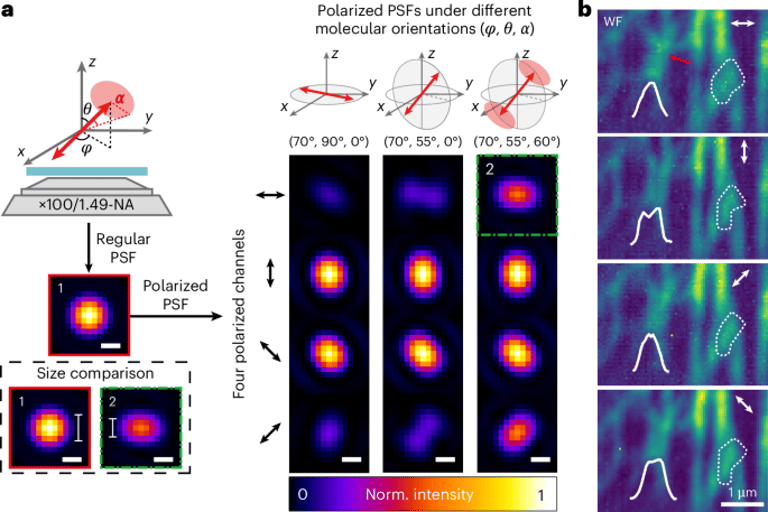

SPIFFI is introduced as a single-shot super-resolution fluorescence imaging method that leverages the polarization properties of fluorescent dipoles across four detection channels to deliver instant sub-diffraction resolution.
Its core innovations include small polarized point spread functions, polarization-modulated fluorescence fluctuations, and image resampling that together yield artifact-free reconstructions from a single frame with enhanced structural fidelity.
Overall, SPIFFI enables fast, multidimensional, single-shot super-resolution imaging with direct readout of dipole orientation and anisotropy, broadening the toolkit for studying subcellular organization and dynamics.
Volumetric imaging in fixed cells of the outer mitochondrial membrane and live-cell mitochondria visualization demonstrate improved 3D resolution (about 178–385 nm axial/lateral range) with reduced photobleaching.
The article notes that full experimental details and the paper are accessible through institutional access, with publisher options for purchase or subscription.
In fixed COS-7 cells, SPIFFI achieves comparable or superior resolution to SIM, resolving microtubule separations around 131–165 nm and providing artifact-free reconstructions relative to other fluctuation-based methods.
Key references include Betzig et al. for nanometer-resolution imaging, Dertinger et al. for SOFI, Gustafsson for SIM, Hafi for polarization-based nanoscopy, and Guo et al. for SPIFFI-inspired concepts.
Experimental validation shows SPIFFI resolving 100-nm beads with lateral FWHM about 173 nm and axial ~385 nm in a single frame, and resolving a 163–165 nm nanoruler structure, outperforming widefield and some SIM approaches in single-shot mode.
Live-cell demonstrations indicate SPIFFI can capture fast 3D dynamics and reduce motion artifacts, including observations of mitochondrial fission and fusion that 2D imaging could miss.
The method enables rapid cellular dynamics capture and provides information on the orientation of fluorescent molecules within cells.
SPIFFI achieves at least about 1.7-fold resolution improvement, reaching ~80 nm after dual-stage reconstruction from single-shot data.
A dual-stage reconstruction, combining SPIFFI with a secondary SOFI-AC step, can reach ~80 nm resolution from 1,000 frames, approaching performance of high-frame-rate SMLM methods.
Summary based on 2 sources
Get a daily email with more Science stories
Sources
Nature • Aug 31, 2026
Polarized detection sharpens optical live-cell fluorescence imaging
Nature • Aug 31, 2026
SPIFFI enables single-shot super-resolution and multidimensional imaging