UC San Diego Scientists Expand DNA Alphabet with Stable Synthetic Base Pairs in E. coli RNA Polymerase
September 2, 2026

The results indicate that P:Z and Z-like analogs are accommodated by E. coli RNA polymerase in a native-like manner, enabling stable transcription of an expanded eight-letter genetic alphabet and guiding design of nucleotide analogues to tune transcriptional dynamics.
UC San Diego researchers, led by Dong Wang, published the findings in Nature Communications on September 2, 2026, with a related PNAS study from the same team reporting recognition of an additional synthetic base-pair without hydrogen bonds.
For the dP:Z*TP pair, three conformational states are observed (TL-open a, TL-open b, TL-closed), with SI3 domain movements during substrate loading and TL engagement, though catalytic metal coordination shows subtler differences in advancing catalysis.
The study builds on prior work with S:B base pairs and outlines the structural basis for transcriptional recognition, fidelity, and the potential to expand genetic information storage and expression in cells.
High-resolution cryo-EM reveals that RNA polymerase recognizes synthetic DNA letters using the same signals as natural base pairs.
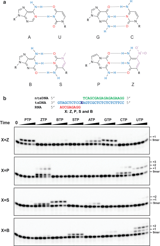
Cryo-EM structures show that P:Z and P:Z* base pairs adopt Watson–Crick geometries in the active site and promote trigger loop folding, with analysis of two distinct elongation complex states.
A higher-fidelity Z* analog (2′-F-α-carboxamide-Z) reduces misincorporation, especially of dZ:GTP and dS:ZTP, while preserving productive P:Z pairing and elongation.
The implications span potential diagnostics, therapeutics, and engineered biological systems that leverage an expanded genetic code beyond natural DNA.
Kinetics show that dZ:PTP and dP:ZTP incorporations are as efficient as natural base pairs, with cognate incorporations greatly outperforming misincorporations under tested conditions.
A nitro-group–mediated π-hole interaction at the dZ site stabilizes a bend in the bridge helix and shifts the trigger-loop folding toward the closed state, increasing dZ:PTP reactivity.
The study provides molecular insight that cellular machinery can process synthetic genetic information, aiding synthetic biology efforts to expand the DNA language.
The work examines how P:Z and B:S hachimoji base pairs are recognized and incorporated by E. coli RNA polymerase, establishing orthogonality and functionality of an eight-letter transcription system.
Summary based on 2 sources