First Direct Radio Signals Detected from Exoplanet Beta Pictoris b, Unveiling Strong Magnetic Field
September 21, 2026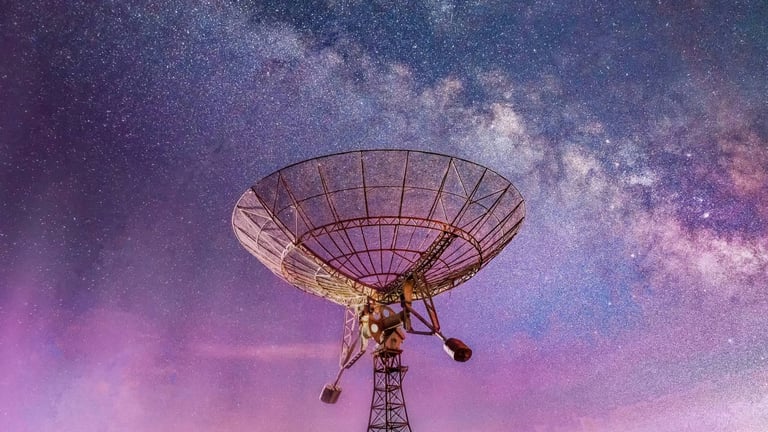

A MeerKAT observation has directly detected radio signals from the exoplanet Beta Pictoris b, marking the first time such emission has been attributed to a planet outside our solar system.
The signals are auroral in origin, not from the host star, and align with a planetary magnetosphere driving radio emission through the Electron Cyclotron Maser Instability mechanism.
This detection provides the strongest evidence to date for an exoplanetary magnetic field, enabling a direct estimate of field strength well above Earth's, with measurements suggesting at least about 1,250 gauss.
Future instruments like the Square Kilometre Array Observatory could dramatically improve sensitivity and eventually allow magnetic-field measurements of smaller, rocky exoplanets in the coming years.
Beta Pictoris b is inferred to possess a very strong magnetic field, thousands of times stronger than Earth's, likely powered by rapid rotation on a timescale of roughly 8 to 9 hours per orbit.
The observed magnetic field strength on Beta Pictoris b exceeds 1,000 gauss, consistent with expectations for a young, massive giant planet near brown-dwarf mass.
The findings have been shared as an arXiv preprint and have not yet appeared in a peer-reviewed journal.
The detection provides new insight into exoplanetary magnetism and dynamo theory, aligning with dynamo-scaling predictions for a young, massive giant planet.
The emission is identified as Electron Cyclotron Maser Instability, the same mechanism behind planetary auroras on Earth and Jupiter, offering a direct measure of the planet’s magnetic field.
If confirmed by peer review, this would be the first direct measurement of an exoplanet’s magnetic field and a landmark observation in exoplanetary science.
The study remains a preprint awaiting peer review, but its potential confirmation would be an exciting advance in understanding exoplanetary magnetospheres.
This observation would represent the strongest evidence to date for a magnetosphere around an exoplanet and the first direct measurement of an exoplanetary magnetic field in astronomy.
Summary based on 3 sources
Get a daily email with more Science stories
Sources
Science News • Sep 21, 2026
First radio waves seen from an exoplanet hint at otherworldly auroras
ScienceAlert • Sep 22, 2026
Astronomers Detect Radio Signals Coming Directly From an Exoplanet For The First Time