Revolutionary Foam-Filled Lattices Promise Durable Buoyancy for Marine Applications
September 21, 2026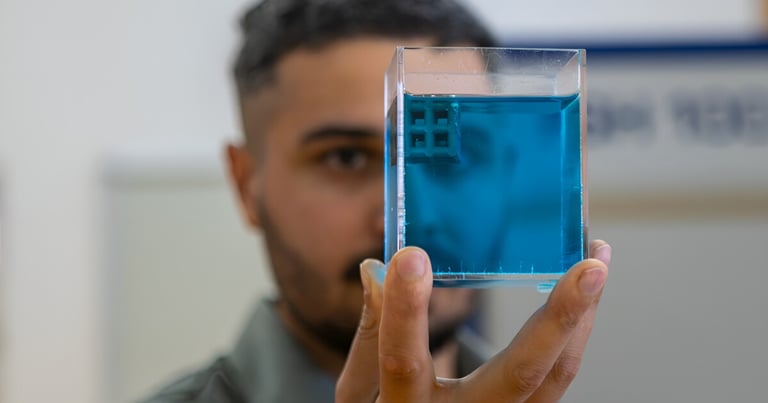

Foam-filled lattices float when skeletal density is below water density and sink when above it, withstanding damage like cracks without sinking until densification occurs.
The research, published in Advanced Materials, aims to broaden the technology’s applications beyond buoyancy.
Tests included long freshwater submersion, minimal seawater mass loss and strength reduction in Port Phillip Bay, and a 100 mm by 85 mm marine buoy prototype demonstrating real-world viability in turbulent flow.
Compared with HDPE and 316L stainless steel, the foam-filled lattice shows higher specific strength, signaling strong strength-to-weight performance for marine use.
Plans ahead include scaling to larger structures, testing long-term durability in real marine and deep-sea environments, and trying different fillers to tailor energy absorption, vibration damping, or thermal management.
The lattice is a 4×4×4 array of 10 mm cells with 0.2 mm walls and 2.5–4 mm internal channels, produced by laser-based powder bed fusion and infused with expandable foam.
Researchers at RMIT created a buoyant titanium–polymer open-cell lattice by 3D-printing hollow Ti-6Al-4V beams and filling them with polyurethane foam to achieve buoyancy without losing strength.
The foam acts as a distributed barrier, limiting water ingress after localized damage and boosting resilience in rough seas.
The buoyancy design relies on skeletal density rather than open external spaces, enabling floatation even though titanium is denser than water.
Summary based on 1 source
Get a daily email with more Science stories
Source

New Atlas • Sep 20, 2026
Scientists create world's first floating titanium