MIT's AI-Powered Flying Robots Achieve Unprecedented Speed and Agility with Somersault Maneuvers
September 22, 2026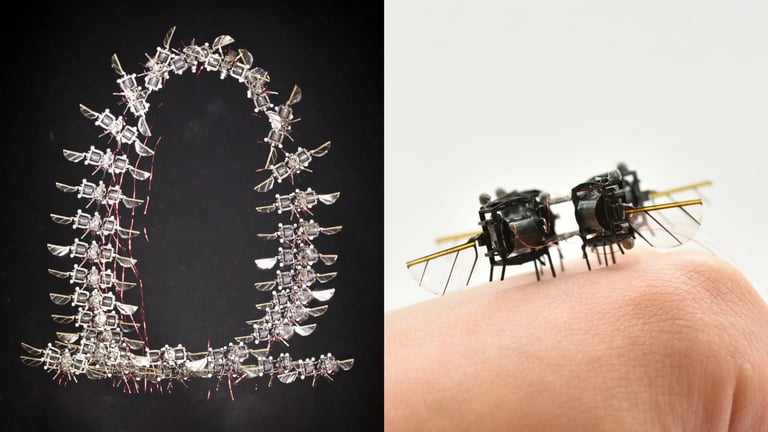


MIT researchers unveiled an AI-based two-part control system that dramatically boosts speed and agility in insect-scale flying robots, enabling demanding maneuvers like repeated somersaults.
Funding for the work comes from NSF, the Office of Naval Research, the Air Force Office of Scientific Research, MathWorks, and the Zakhartchenko Fellowship.
The team envisions future outdoor, autonomous operation with onboard cameras and sensors, removing the need for external motion capture and enabling coordinated flights among multiple microrobots to avoid collisions.
A saccade-like maneuver was demonstrated to rapidly shift and reorient the robot, improving navigation and visual processing.
The system integrates a model-predictive controller for precise planning with an imitation-learning policy that runs in real time to drive thrust and torques.
Key researchers include PI Kevin Chen, Yi-Hsuan Hsiao, Andrea Tagliabue, Owen Matteson, Suhan Kim, Tong Zhao, and Jonathan P. How, with findings published in Science Advances.
The approach achieved a roughly 447% increase in speed and a 255% boost in acceleration over previous results, with the robot executing 10 somersaults in 11 seconds along a constrained flight path.
Hardware gains include larger wings powered by soft artificial muscles, enabling faster wingbeats and greater agility while the AI controller manages uncertainty and complex aerodynamics.
Summary based on 1 source
Get a daily email with more AI stories
Source
ScienceDaily • Sep 22, 2026
MIT’s tiny flying robot gets 450% faster with AI