Gravitational Torque Key to Earth's Rotation Variations Over Decades, Study Finds
September 23, 2026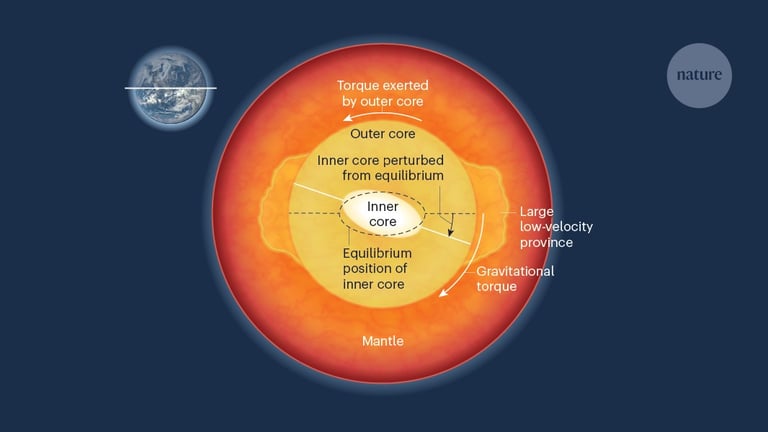

A new study integrates seismology, geomagnetic data, and core-flow modeling to show that gravitational torques between the inner core and mantle drive multidecadal changes in Earth's rotation, causing day-length variations of a few milliseconds.
Over a proposed 70-year cycle, the inner core wobbles about 2.35 degrees relative to the mantle; around 2010 the wobble’s direction shifted, after which the core appears to move backward from the mantle’s perspective.
The variation appears to originate from deep Earth interactions among the inner core, outer core, and mantle, influencing rotational dynamics on decadal timescales.
Context and sources include the Nature study, earlier work by Yang and Song (2023), and university communications framing the discovery.
Electromagnetic coupling yields MAP estimates of about 1.4×10^19 N·m with a relaxation timescale near a decade, while topographic coupling can reach ≈4.2×10^19 N·m with timescales from about 1.7 to 21.5 years, and similar overall length-of-day fits.
Researchers Huifeng Zhang and Mathieu Dumberry used statistical models to compare observed data from the last six decades and quantify contributions from the three coupling mechanisms.
Building on a 2023 Peking University study suggesting a 70-year rhythm, the new model provides the physical mechanism behind the motion.
A Bayesian inversion explores gravitational torque strength, inner-core relaxation time, and coupling parameters to fit 1964–2019 multidecadal ΔLOD, with gravitational torque generally dominating over resisting CMB torques.
Results indicate multidecadal ΔLOD arise from small imbalances between long-term gravitational torque and CMB torques, with gravity driving the net changes and CMB torques acting as opposition.
Constraints suggest a low-degree geoid/topography at the CMB and a shallow, low-viscosity interface between inner and outer core, aligning with emerging mantle dynamics concepts.
Over roughly a decade, the core’s surface deforms by about ten meters due to this motion, though the effect is minute and not detectable at the surface.
The inner core behaves as a viscous, extremely hot solid, enabling slow, pendulum-like deformation under extreme conditions.
Summary based on 7 sources
Get a daily email with more Science stories
Sources

Gizmodo • Sep 23, 2026
Something Deep Inside Earth Keeps Messing With the Length of Our Days
Nature • Sep 23, 2026
Gravitational torque drives multidecadal variations in length of day
Nature • Sep 23, 2026
Gravitational tug-of-war inside Earth is changing the length of our days
Nature • Sep 23, 2026
Gravitational forces inside Earth drag some decades out — and make others fly by