Study Reveals Urbanization and Climate Change Fueling Global Infectious Disease Outbreaks
September 23, 2026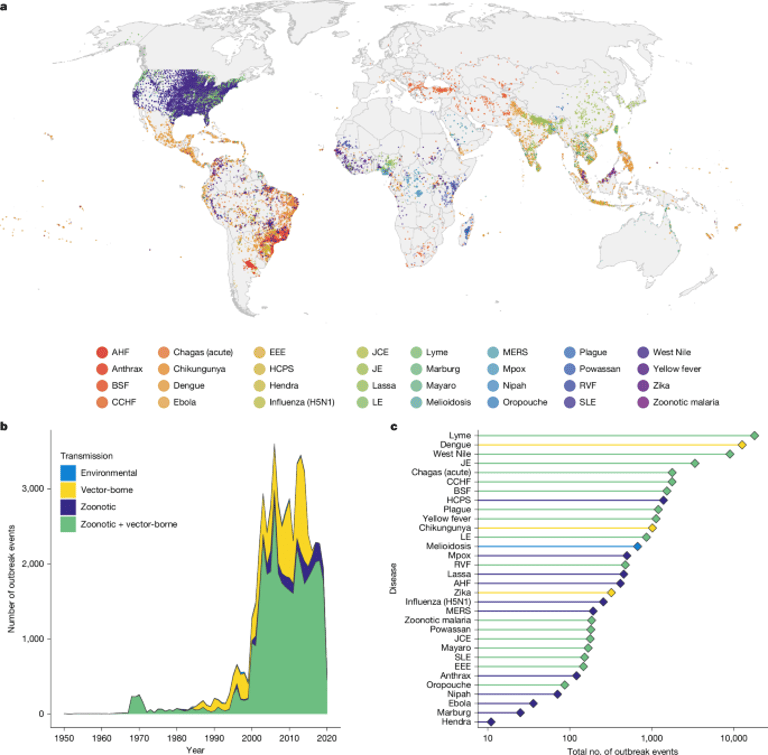

Across 31 diseases, urbanization, healthcare access, fragmentation, and forest cover act as pervasive detection biases and risk factors, while long-term precipitation changes correlate with several vector-borne diseases, indicating climate trends shape susceptibility.
The study is co-led by Sadie Ryan with collaboration from University College London and Yale, and includes UF researchers from the Emerging Pathogens Institute.
Researchers apply a standardized geospatial case-control framework with 16 covariates spanning detection processes, socioeconomic factors, ecosystem structure, land use change, and climate change, using Bayesian geospatial logistic regression to infer outbreak drivers.
Outbreak drivers differ by disease; directly transmitted diseases show fewer consistent environmental predictors, suggesting multicausal spillover driven by social and ecological systems.
The findings call for One Health approaches with integrated surveillance and region- and disease-specific interventions.
Limitations include data sparsity, spatial-temporal misalignment between infections and covariates, and residual detection biases that complicate separating true risk from reporting artifacts.
Validated associations include biodiversity intactness reducing Lyme disease risk, long-term drying increasing dengue risk, high poultry density elevating avian influenza A/H5N1 risk, and forest loss linked to mpox and zoonotic malaria; surveillance quality enhances reliability.
A global analysis of about 58,000 outbreak events in 169 countries (1900–2022, concentrated after 2000) links emergence to human-driven environmental changes and detection biases.
This Nature study analyzes how human activity and environmental factors shape where emerging infectious diseases occur, across a large international dataset.
Initial outbreak hotspots are strongly influenced by detection and reporting biases (urban centers and proximity to healthcare), but after adjustment, risk rises with forest cover, fragmentation, and livestock density, with regional variation.
The study stresses multiple interacting processes behind outbreak risk and calls for longitudinal, system-specific ecological studies to refine interventions beyond single-disease inferences.
Access to healthcare substantially affects reporting, with outbreak reports dropping about one-third for each hour longer to reach the nearest facility, indicating under-detection in areas with limited health infrastructure.
Summary based on 2 sources