Atomic Steps Guide Quantum Vortices, Paving Way for Ultralow-Power Superconducting Tech
September 24, 2026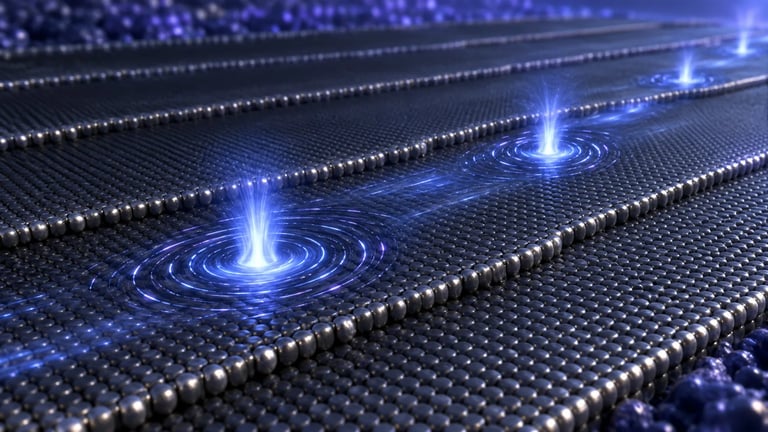

The research highlights potential applications in ultralow-power superconducting devices and more efficient processing through controlled vortex dynamics.
A research team from MANA/NIMS demonstrated that one-atom-high surface steps on ultrathin superconductors act as directional rails that guide vortices along the steps with much lower resistance than across them.
The atomic-scale steps can channel magnetic flux and local heat flow in nanoscale superconducting circuits, suggesting a path to ultralow-power computation and highly efficient quantum information processing.
At the atomic scale, single-atom-high steps serve as effective rails for guiding quantum vortices, offering potential control of vortex motion and heat flow in future superconducting technologies.
The work is foundational and not a ready-made qubit architecture; it was conducted under ultrahigh vacuum at 0.4–4.2 kelvin on an atomic-layer material, with theoretical work still needed for quantitative analysis of the highly anisotropic system.
The findings were reported in Physical Review B on July 30, 2026, by Takashi Uchihashi and colleagues from MANA/NIMS.
Contextual background includes the broader MANA program, the WPI initiative, and links to related research highlights and resources.
Scanning tunneling microscopy confirmed vortices located along the parallel atomic steps.
The study used an atomic-layer superconductor grown on vicinal surfaces with parallel, regularly arranged atomic steps and visualized vortices along these steps with scanning tunneling microscopy.
The experiment used Si(111)-(√7×√3)-In with terraces about 89 nanometers wide and steps roughly 0.31 nanometers high, aligning with Josephson vortex cores and weakly coupling neighboring terraces like a line of Josephson junctions.
At the lowest temperatures, vortex transport shifted from thermally activated motion to quantum tunneling along the steps, and the guiding efficiency could be tuned by external magnetic fields and temperature.
Experiments showed strong transport anisotropy: vortices moved over 1,000 times more easily parallel to the steps than perpendicular at intermediate fields, indicating directional control of vortex motion.
Summary based on 3 sources
Get a daily email with more Science stories
Sources

Open Access Government • Sep 24, 2026
Atomic-scale “Rails” guide superconducting vortices in ultrathin materials
EurekAlert! • Sep 24, 2026
MANA reveals atomic-scale rails for guiding superconducting vortices
Unite.AI • Sep 24, 2026
Atomic Steps Steer Quantum Vortices 1,000 Times More Easily