Breakthrough in Watermelon Fertility: Key Genes Identified for Hybrid Seed Production
September 26, 2026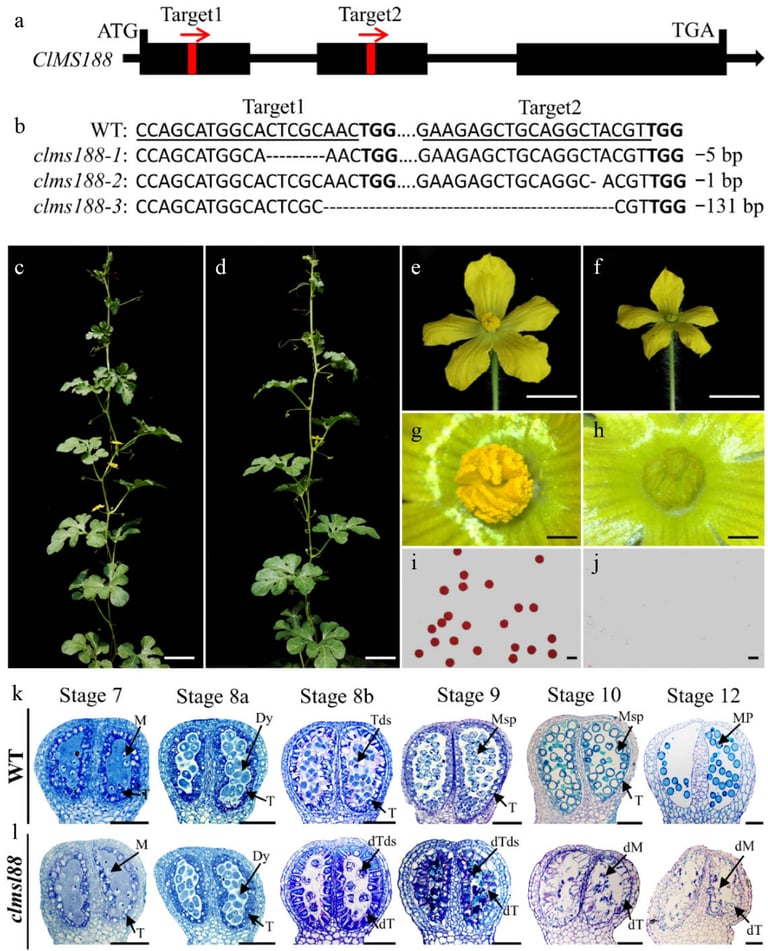

A Seed Biology study identifies the ClMS188–ClMS1L1 regulatory module as essential for male fertility in watermelon, with important implications for hybrid seed production.
Anther defects in clms188 appear at the tetrad stage (stage 8b) including malformed tetrads and shrinking microspores, while clms1l1 defects emerge later (stage 9) with deformed microspores and abnormal tapetum expansion.
RNA sequencing shows 1,875 differentially expressed genes in clms188 and 2,266 in clms1l1, with 710 genes in common, impacting hormone signaling and phenylpropanoid biosynthesis pathways.
ClMS188 primarily affects tetrad-wall degradation and sporopollenin precursor metabolism, whereas ClMS1L1 more strongly influences lipid metabolism and pollen-coat precursor production, indicating two linked but distinct pollen-coat formation pathways.
ClMS188 activates the ClMS1L1 promoter by binding a TAACCA motif, establishing a direct regulatory relationship between the two genes.
CRISPR/Cas9 knockouts of each gene yield completely male-sterile plants with indehiscent anthers and nonviable pollen, underscoring their essential roles in fertility.
Both ClMS188 and ClMS1L1 are nuclear transcription factors expressed in developing anthers, with ClMS188 peaking at the tetrad stage and ClMS1L1 peaking during microspore release (stage 9).
Targeting the ClMS188–ClMS1L1 module could enable scalable hybrid seed production, reduce breeding costs, and speed the introduction of desirable traits in commercial watermelon.
The work extends a conserved anther-development pathway to watermelon, showing adaptation for insect-pollinated crops and yielding edited lines with clean male-sterile phenotypes suitable for hybrids.
Summary based on 1 source
Get a daily email with more Science stories
Source
Newswise • Sep 26, 2026
Genetic module unlocks male sterility for hybrid watermelon breeding | Newswise