AI Unveils Moth Pheromones: New Pathway for Pest Control
September 27, 2026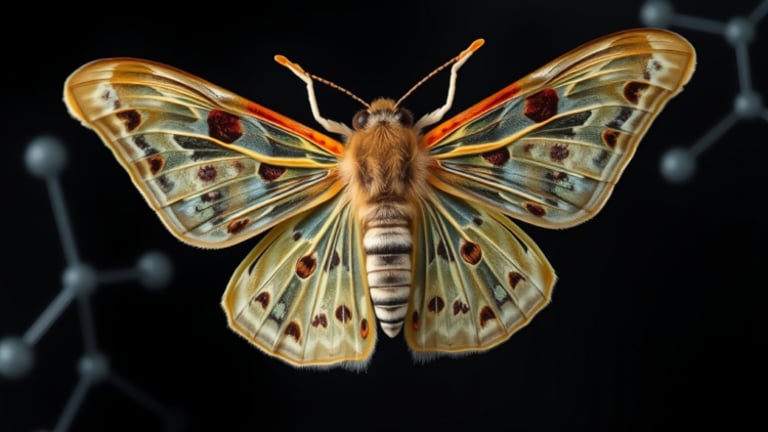

A French INRAE team unveils an AI-guided pipeline that predicts a moth’s sex pheromone from olfactory receptor structures, enabling identification of pheromones for non-model species.
The approach starts with the male moth’s odor receptors, uses genomics to narrow candidate receptors, and applies machine learning to predict three-dimensional receptor structures.
Structural models are used to dock a library of volatile compounds, pinpointing (Z,E)-9,11-tetradecadienyl acetate as the predicted pheromone that would interact with the receptors.
Electrophysiology confirms receptor–ligand interactions, and additional analyses verify that the female lily moth secretes the compound and that males detect it.
Behavioral assays demonstrate that the identified molecule attracts male lily moths and triggers mating behavior, confirming it as the species’ pheromone.
The lily moth (Spodoptera picta) serves as a test subject, illustrating the method’s applicability to non-model, non-laboratory species and real-world pest-control scenarios.
This method could accelerate pheromone identification for invasive or hard-to-rear species, enabling more specific mating disruption and pheromone-baited traps.
Beyond this case, pheromones as species-specific signals support reproductive isolation and evolutionary studies, with AI-assisted predictions expanding knowledge across diverse insect groups.
The pipeline holds promise for broad future work in monitoring and controlling pests while reducing reliance on traditional, labor-intensive chemical ecology workflows.
Overall, the study demonstrates a viable AI-guided path from receptor structure to practical pheromone discovery, with clear implications for scalable pest management.
In sum, the work could speed identification of pheromones for invasive species and non-laboratory contexts, improving specificity and effectiveness of pheromone-based control strategies.
The research underlines a broader scientific impact by linking AI predictions with evolutionary and ecological insights across insect groups.
Summary based on 1 source
Get a daily email with more Science stories
Source

BIOENGINEER.ORG • Sep 27, 2026
Scientists Reverse-Engineer Insect Smell Receptors to Identify Moth Sex