Unexpected Dip in Collision Data Hints at Possible QCD Phase Transition
September 28, 2026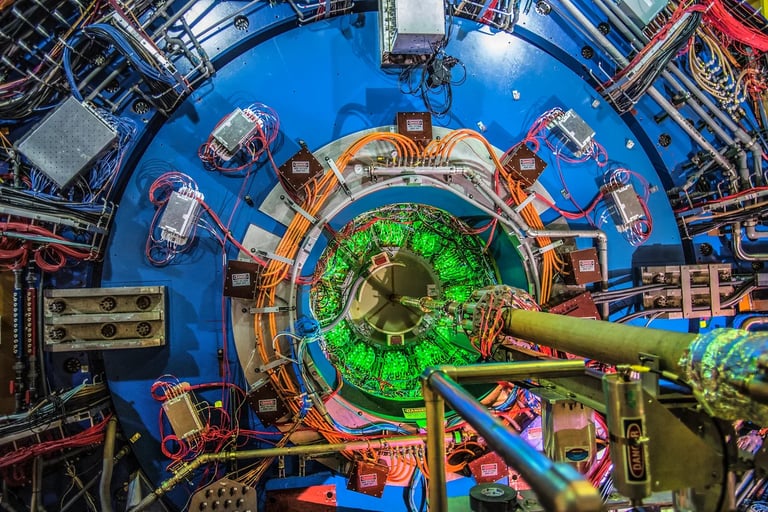

The observed dip occurs at collision energies that align with some of the densest states realized in laboratory settings and could signal the presence of a critical point in the QCD phase diagram.
However, interpreting the signal is tricky, since a single observable cannot definitively prove a critical point; alternative explanations, such as energy-dependent changes in particle composition, could produce a similar effect.
If a true critical point is confirmed, it would deepen our understanding of the universe’s early evolution and shed light on how matter behaves at extreme densities, with implications for neutron stars and potential black-hole formation.
Physicists at Brookhaven National Laboratory recreate quark-gluon plasma by colliding gold ions at near-light speeds, reproducing conditions similar to the early universe.
The STAR experiment at RHIC detected an unexpected dip in fluctuations of transverse momentum in the debris from collisions, hinting at a possible phase transition in dense nuclear matter.
Summary based on 1 source
Get a daily email with more Science stories
Source

Scientific American • Sep 28, 2026
Surprising result seen in primordial matter inside atom smasher