Unveiling Human Meningeal Development: A Multiomics Atlas Highlights Key Lineages and Trisomy 21 Effects
September 28, 2026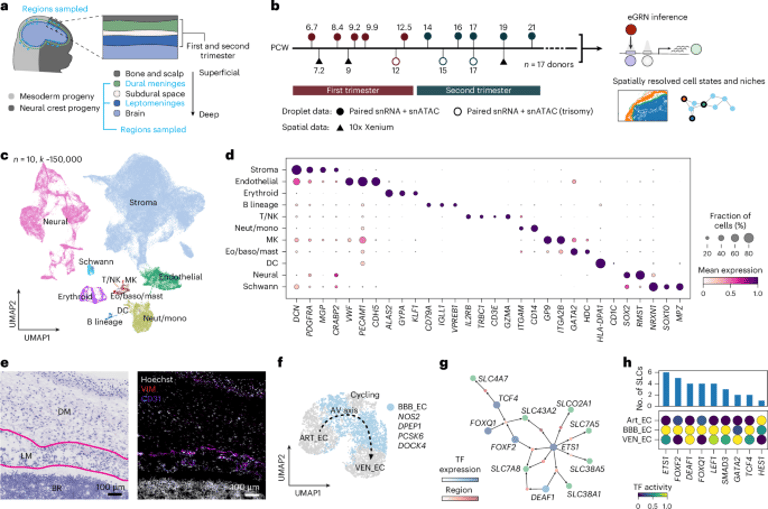

We present a comprehensive transcriptional and epigenetic atlas of human meningeal development from embryonic to fetal stages, highlighting fibroblast lineages, BBB-associated endothelial cells, myeloid and B cell lineages, and notable effects of trisomy 21.
Spatial fibroblast mapping reveals seven fine-grained states (Pia_FIB, Arach_FIB, Dura_FIB, Cycling_FIB, etc.) plus a small pre-osteoblast population; Pia_FIB and Cycling_FIB appear earlier, while Arach_FIB and Dura_FIB emerge later, suggesting developmental lineage relationships.
The study combines paired snRNA and snATAC sequencing with high-plex spatial transcriptomics, using MILO for differential state analysis, CellTypist for label transfer, SCENIC+ for regulatory networks, and Nichefinder for spatial niche inference.
Meningeal myeloid niches include macrophage progenitors, meningeal macrophages, and LYVE1-expressing BAMs; Pre_MAC and MG trace to yolk sac–like origins, with BAMs enriched near vasculature and MG in deeper brain regions and potential TGFB1/IGF1-mediated angiogenic signaling for BAM_FOLR2low.
The cellular taxonomy identifies 51 transcriptional clusters spanning pial, arachnoid, and dural fibroblasts and diverse immune lineages, mirroring adult meninges complexity.
In trisomy 21 meninges, a gene-dosage effect shapes expression broadly, with stromal and erythroid cells depleted and Pia_FIB disproportionately affected; JAK–STAT, KRAS, and MTORC1 signaling upregulated in immune compartments, and chemokine signaling downregulated in stromal cells.
BBB endothelial development profiles arterial, venous, and cycling states, validated against brain vasculature atlases, with ETS1-regulated transport networks and transporters such as SLC7A5, SLC7A8, and SLC43A2 highlighted.
Meningeal B cells are enriched in the second trimester, aligning with the trajectory of meninges-resident B cells and suggesting prenatal establishment of meningeal B cell compartments.
Pseudotime analysis places Pia_FIB as early progenitors branching into Arach_FIB and Dura_FIB, with layer-specific markers supported by first-trimester data and neural crest signaling enriched in combined anterior regions.
The findings illuminate the ontogeny of meningeal fibroblasts and immune populations, with implications for CNS barrier immunity, meninges-related diseases, and conditions like Down syndrome.
Overall, the work provides a multiomics, cross-gestational map linking cellular lineages to spatial organization and disease-associated states in human meninges.
Summary based on 1 source