New TT-Derived Method Revolutionizes Carbene Transfer, Enhancing Safety and Versatility in Metal-Catalyzed Reactions
September 30, 2026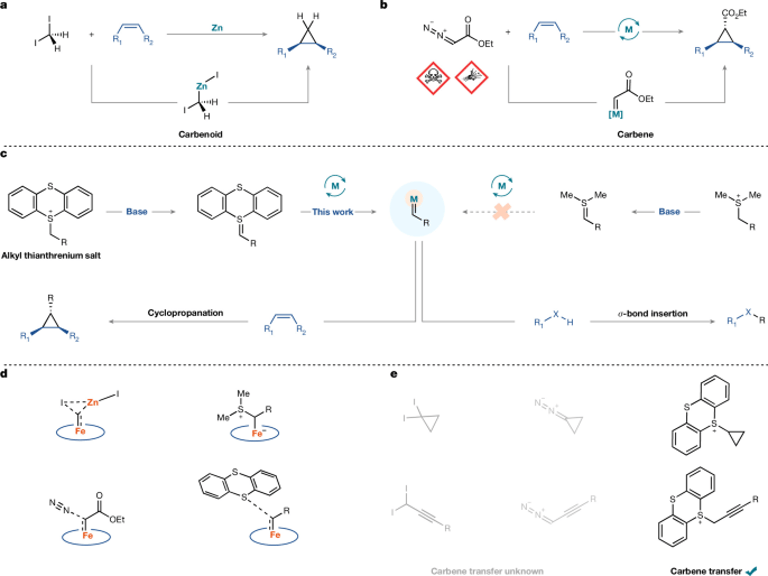

The TT-derived approach expands carbene transfer beyond cyclopropanation, enabling copper- and iron-catalysed carbene transfers, as well as sigma-bond insertions (Si–H, Ge–H) and Doyle–Kirmse-type sigmatropic rearrangements, demonstrating broad versatility across metal–carbene chemistry.
Safety and scalability are strong with TT salts showing no detectable exotherm, and ball-mill, solvent-free methods delivering high yields (for example, carvone cyclopropanation reaches 74% in a ball mill, compared with 87% in a small-scale toluene suspension).
General conditions for Fe- and Cu-catalysed cyclopropanation employ alkylthianthrenium salts in toluene with Cs2CO3 as base under inert atmosphere; solvent and base choices affect yield, and heterogeneous mixtures can enhance performance.
The article presents alkylthianthrenium salts as distinct from conventional sulfonium donors, enabling general metal–carbene generation and transfer, notably for cyclopropanation across a broad olefin scope.
TT-derived cyclopropanation tolerates a wide array of olefins—including α-olefins, 1,1-/1,2-/trisubstituted olefins, enol ethers, enamides, diverse styrenes, dienes, and enynes—with functional groups such as esters, halides, ketones, amides, alcohols, aldehydes, and epoxides; Lewis-basic amines and thiols are problematic.
Iron phthalocyanine catalysis with MeTT+ salts improves efficiency on certain substrates (e.g., sesquiterpene + β-cedrene reaches 92% with Fe(Pc) vs 25% with Fe(TPP)Cl), indicating broader olefin compatibility due to enhanced electrophilic reactivity.
The TT platform provides a general, practical alternative to diazo compounds and dihaloalkanes for carbene-transfer chemistry, with potential for broad adoption and further development in various catalytic contexts.
The rationale hinges on thianthrenium ylides offering a distinct energy landscape that lowers barriers to electrophilic metal–carbene formation, supported by spin-state analysis and activation-strain considerations, addressing limitations of conventional sulfur ylides.
Summary based on 1 source
Get a daily email with more Science stories
Source
Nature • Sep 30, 2026
Carbene transfer from thianthrenium ylides for cyclopropanation