New Framework Predicts Network Oscillation Transitions, Validated with C. elegans Neural Network
October 6, 2026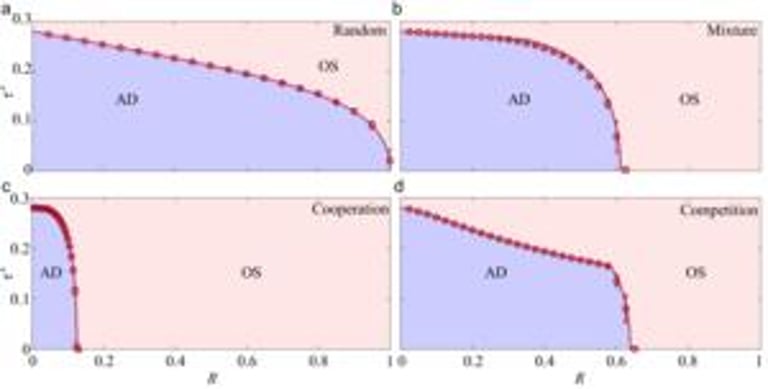

A framework links network complexity, propagation delays, and interaction types to predict when a network transitions from amplitude death to sustained oscillations.
Predictions are validated with a digital–analog hardware emulation platform, showing the transition remains robust under sampling, quantization, and hardware imperfections.
The framework is applied to a biologically derived topology, specifically the C. elegans neural network, illustrating practical applicability beyond idealized models.
Overall, the work offers an integrative analytical and experimental method to forecast when large interconnected systems will begin to oscillate, with potential relevance to neural, cardiac, ecological, and engineered networks.
Using networks of coupled Stuart–Landau oscillators, the study shows that higher effective network complexity lowers the critical delay for oscillations, and in very complex networks oscillations can emerge even without delay.
Interaction type—whether cooperative, competitive, mixed, or random—shifts the boundary between amplitude death and sustained oscillations in the complexity–delay space, with cooperative interactions favoring oscillations at lower complexity.
Summary based on 1 source
Get a daily email with more Science stories
Source
EurekAlert! • Oct 6, 2026
What shape the oscillatory transitions in complex networks?