Bio-Inspired Aerogel Sets Record in Microwave Absorption, Revolutionizes EMI Shielding and Stealth Tech
October 7, 2026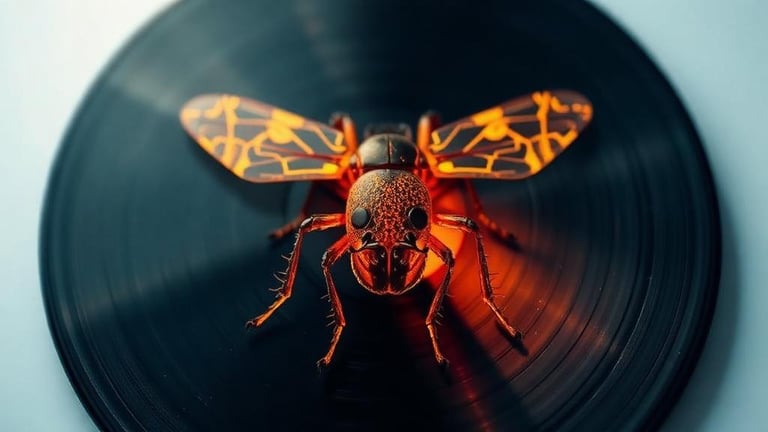

A bio-inspired aerogel, modeled on principles from the fire-beetle Melanophila acuminata, achieves ultrabroadband microwave absorption from 2 to 18 GHz, delivering a record 9.43 GHz absorption bandwidth for a carbon-based absorber and a minimum reflection loss of −63.10 dB.
The material uses a three-dimensional porous carbon framework loaded with CeO2 and MXene nanosheets, attaining very low density (0.018–0.117 g/cm³) and ultralow filler content (3.74 wt%), while leveraging dielectric and interfacial losses for strong absorption.
Practical relevance is demonstrated by a significant reduction in radiation intensity on a chip within a device (from ~110 V/m to 10–40 V/m), highlighting potential for EMI shielding, stealth coatings, and protection for dense wireless electronics in aerospace, defense, and consumer tech.
Computational modeling (Voronoi-like framework, density functional theory) and simulations (COMSOL, ABCD matrix) reveal strong MXene–CeO2 electronic coupling, built-in interfacial dipoles, and predicted reflection losses below −10 dB across most of the 2–18 GHz band.
The work emphasizes functional translation of beetle-inspired sensing principles rather than exact geometric copying, preserving multiscale impedance regulation and interfacial energy dissipation in a microwave-targeted metamaterial.
The material remains mechanically resilient, thermally insulating, and fire-resistant, with epoxy templating enhancing thermal conductivity and glass transition temperature through the carbon network.
Broader significance shows a biological sensing strategy can inspire metamaterials across EM spectrum regions, achieving broadband, ultralow-density absorption via a synergy of ceria dielectric loss, MXene conductivity and interfacial losses, and oxygen-vacancy–driven polarization.
Experimental fabrication involved freeze-dried, argon-heat-treated melamine foam templates impregnated with CeO2 and MXene, producing durable aerogels whose porous network remains cohesive after resin impregnation and testing.
Measurements on CMX5 and CMX3 samples show broad bandwidths at low densities: CMX5 achieves −63.10 dB at 13.58 GHz over a wide band; CMX3 covers 9.43 GHz (6.70–16.13 GHz) at 3.74 wt% loading, outperforming prior carbon-based absorbers.
The beetle’s infrared-sensing nanostructures are translated into cavities and interspaces for impedance matching, synaptic-like protrusions forming rough interconnected carbon struts, nanoscale wrinkles and pores for interfacial polarization, and CeO2 oxygen vacancies enhancing energy dissipation.
Summary based on 1 source
Get a daily email with more Science stories
Source

BIOENGINEER.ORG • Oct 7, 2026
Fire-Beetle-Inspired Aerogel Absorbs Microwaves Across a Record-Broad Band