Solar System Chaos: Study Predicts Planetary Instability as Sun Ages
October 9, 2026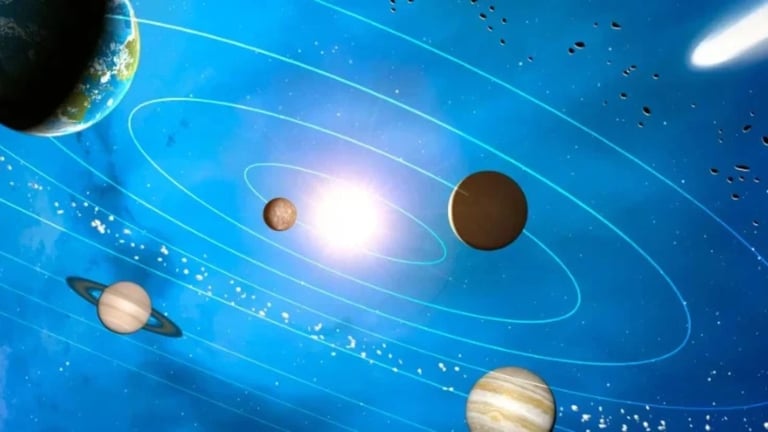

Across nearly 700 simulations, about 80% of the most realistic scenarios show the outer planets beginning to cross orbits long before the Sun finishes shedding its outer layers, with 40% leading to a disordered Solar System by the time the Sun becomes a white dwarf.
A new study published in The Astrophysical Journal Letters argues that the Sun’s mass loss as it ages will be turbulent and occur in thousands of discrete ejection events, rather than as a smooth, gradual process.
The findings suggest that planetary-system instability may be more common and faster in the cosmos, aligning with observations of free-floating planets and challenging the notion of a tranquil planetary retirement.
The research, led by Konstantin Batygin and Jim Fuller of Caltech and Fred Adams of the University of Michigan, uses Gaia data and simulations to show that these random “kicks” in mass loss can cumulatively alter the Sun’s gravity enough to destabilize the outer Solar System.
In their simulations, each mass-loss kick could eject about 0.01% of the Sun’s mass (roughly 33 Earths) over 4,600 events, causing the Sun’s speed to fluctuate by about seven meters per second per event.
Potential outcomes include Uranus and Neptune swapping orbits or venturing into Jupiter’s path, Saturn potentially being ejected, and a majority of simulations resulting in at least one giant planet leaving the system.
Overall, the study projects that in about 90% of models, the Solar System could be disrupted within three billion years after the Sun becomes a white dwarf, implying a destruction timescale far shorter than previously thought.
Summary based on 1 source
Get a daily email with more Science stories
Source
ScienceAlert • Oct 9, 2026
Our Solar System May Be Destroyed 100 Times Faster Than We Thought