NGRST Launches to Explore Exoplanets and Dark Energy, Offering Wider Sky Imaging Than James Webb
October 15, 2026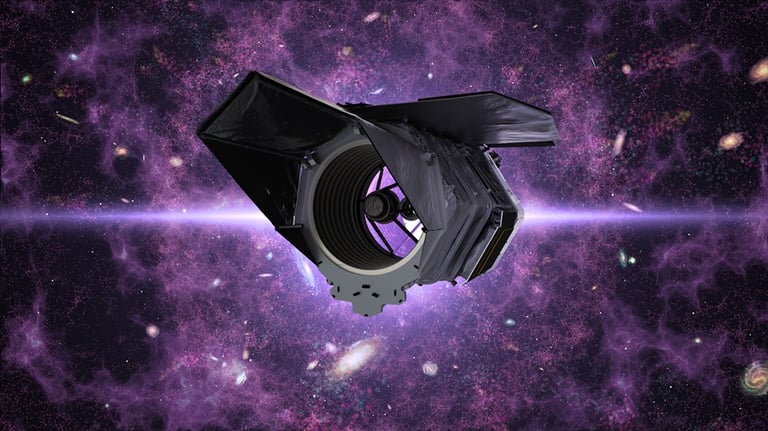

NGRST will orbit about a million miles from Earth, arriving at its location in early December, and has three main science objectives: identifying and characterizing exoplanets, conducting a wide-field infrared survey of the sky, and improving understanding of dark energy.
The piece closes with a brief author bio for Justin Samaha, an amateur astronomer who occasionally sets up his telescope on Outer Cape beaches and piers.
The article contrasts NGRST with the James Webb Space Telescope, noting Webb’s high sensitivity but narrow field of view, whereas NGRST prioritizes wide-field imaging.
The telescope is not visible from Earth due to its distance, but readers are invited to observe the eastern sky after sunset toward Pisces where it is located, adding a note of appreciation for pure science.
The article discusses NASA's Nancy Grace Roman Space Telescope (NGRST), launched on August 30, and its purpose to advance space science beyond for-profit space activities.
The infrared survey objective focuses on revealing structures obscured by dust and hydrogen, complementing the James Webb Space Telescope by offering a wider field of view at infrared wavelengths.
For exoplanets, NGRST aims to discover thousands of smaller, farther-orbiting worlds using advanced onboard instruments, expanding the current catalog of around 6,300 exoplanets.
The third objective targets dark energy by mapping ancient galaxies to study the universe’s expansion and provide clues about this unknown energy driver.
Summary based on 1 source
Get a daily email with more Science stories
Source

The Provincetown Independent • Oct 15, 2026
A New Space Telescope Opens Its Eyes to the Universe