Cell Division: A Morphogenetic Force in Tissue Architecture Revealed by Mouse Organoid Study
October 16, 2026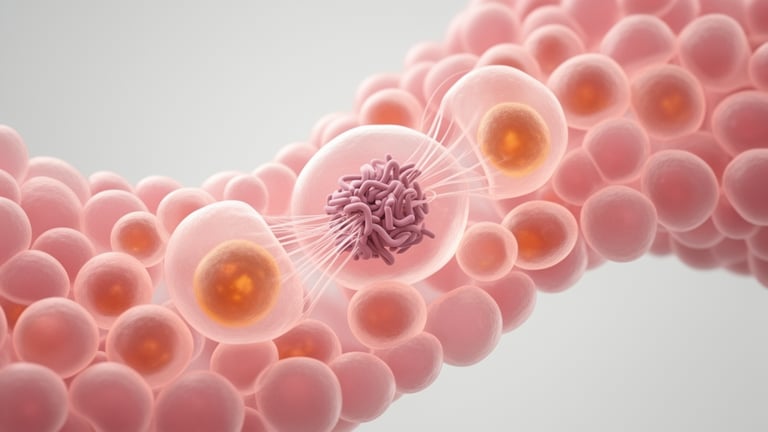

Cell division actively reshapes surrounding tissue in epithelial sheets, not merely increasing cell numbers, as seen in mouse intestinal organoids.
A drug that arrests division before daughters return to the basal surface halted 93 percent of neighbor exchanges, showing withdrawal and reinsertion are separate processes with distinct roles in remodeling.
Organoids reveal a consistent sequence in basal surface dynamics: rosette formation, neighbor exchange, and rearrangement tied to the geometry of the mitotic daughters.
Open questions remain about how basement membrane and tissue mechanics influence division-driven remodeling and whether the rules observed apply to other growing tissues.
The two daughter cells become about 30 percent less circular than the mother cell, creating an elongated footprint that directs neighbor rearrangements typically perpendicular to the division line.
These findings have implications for epithelial biology in cancer, wound healing, organ regeneration, and early tumor formation, where maintaining or losing tissue architecture during growth is critical.
The study reframes proliferation: division acts as a morphogenetic engine that directly shapes tissue architecture, blending growth and remodeling rather than treating them as separate steps.
During mitosis, a dividing cell withdraws from the basal surface creating a temporary gap, rosettes form as neighbors converge, then the daughters reintegrate and their elongated shape drives subsequent neighbor swapping.
Summary based on 1 source
Get a daily email with more Science stories
Source
BIOENGINEER.ORG • Oct 16, 2026
Cell Division Does More Than Make New Cells: It Helps Reshape Tissues