Breakthrough in Scalable Quantum Computing: High-Fidelity Control Achieved with Silicon Spin Qubits
October 16, 2026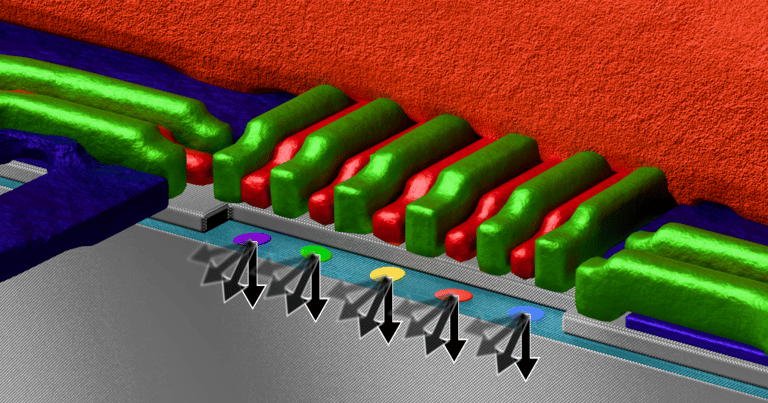


A path toward scalable silicon-spin-qubit quantum processors is viable, with fault-tolerant computing prospects supported by the demonstrated high-fidelity control on a shared microwave line.
The work shows that parallel operation can be achieved reliably through shared microwave control lines, indicating silicon spin qubits as a practical route to large-scale quantum computers.
Researchers use pairwise phase calibration to correct phase shifts, measuring how driving one qubit affects another and combining these corrections to address larger groups without calibrating every qubit pair individually.
This pairwise approach avoids exponential calibration demands by compensating unwanted phase shifts through targeted, scalable adjustments.
The device uses isotopically purified silicon-28 in a silicon-germanium structure with overlapping gates forming five quantum dots, supplemented by sensors for readout and a cobalt magnet to create distinct qubit resonance frequencies.
Drive-induced decoherence remains a remaining error when all five qubits run in parallel, with overall fidelities around 99.9% due to higher microwave power.
Randomized benchmarking quantified single-qubit gate fidelities, noting that the reported figures reflect average fidelities for single-qubit rotations rather than an entire five-qubit algorithm or entangling gate.
Key researchers include Yi-Hsien Wu and Leon Camenzind as co-authors, with Seigo Tarucha as project manager, under JST’s Moonshot Goal 6.
The study is published in Nature Physics, Wu, YH., Camenzind, L.C., Bütler, P. et al., Simultaneous high-fidelity single-qubit gates in a spin qubit array (2026), DOI: 10.1038/s41567-026-03466-2.
Future work aims to reduce drive-induced decoherence and microwave power needs, potentially by redesigning device geometry or magnetic-field gradients to lessen accuracy loss during parallel operation.
Parallel control benefits from tailored pulse shapes and calibrated drive amplitudes, in addition to pairwise phase corrections, enabling more accurate multi-qubit operations on a shared line.
Five-qubit silicon devices demonstrated high single-qubit fidelity during parallel operation, with several qubits achieving above 99.99% and all five around 99.9%.
Summary based on 3 sources
Get a daily email with more Tech stories
Sources

Tech Explorist • Oct 16, 2026
Three silicon qubits, 99.99% precision: A quantum computing breakthrough
The Brighter Side of News • Oct 16, 2026
Silicon spin qubits reach 99.99% fidelity bringing larger quantum processors into reach
Quantum Zeitgeist • Oct 16, 2026
Riken Institute’s Work Scales Up Silicon-based Quantum Processors