Discovery of Massive Exosatellite Orbiting Brown Dwarf Challenges Planet-Moon Classification
October 25, 2026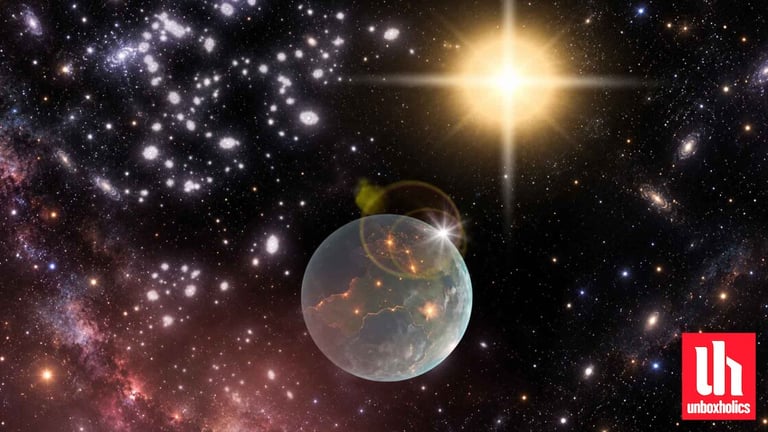

Astronomers using ESO's Very Large Telescope have found evidence of a massive moon-like body orbiting a brown dwarf in the CD-35 2722 system, potentially the first exosatellite detected outside the Solar System.
Researchers, including Kevin Hoy, describe the system as difficult to classify with traditional terms like planet and moon, and refer to the object as an exosatellite with a mass at least that of Jupiter.
The brown dwarf is more than 30 times as massive as Jupiter, making the satellite significantly more massive than any known Solar System moon.
The study reporting these findings was published in Nature, with the specific article linked in the report.
If confirmed, this discovery could redefine how astronomers distinguish moons from planets and would influence understanding of how planetary systems form and evolve.
Confirmation of exosatellites would illuminate how planetary systems form and evolve, and explain diversity among systems compared to our Solar System.
A key challenge highlighted is the lack of universally accepted definitions for exomoons and exosatellites, given that the satellite might be considered a planet under some classification schemes.
Prior reports of potential exomoons (e.g., in HD 206893) did not yield definitive detections; CD-35 2722 offers stronger evidence albeit still under study.
The upcoming ESO Extreme Large Telescope (ELT) could enhance exomoon searches with its 39-meter aperture and advanced instruments.
Future observations, including with ESO’s upcoming ELT, could determine whether such massive satellites are rare or common and enable detection of smaller exomoons.
Radial velocity fluctuations are interpreted as evidence for a gravitationally bound satellite, leading scientists to characterize the object as a potential exomoon.
Alice Zurlo of YEMS emphasizes the satellite as a giant gaseous body orbiting a highly massive companion several times Jupiter’s mass, further blurring traditional categories.
Summary based on 3 sources
Get a daily email with more Science stories
Sources
ScienceDaily • Oct 24, 2026
Astronomers may have discovered the first moon beyond our Solar System
The Business Standard • Oct 25, 2026
Astronomers report possible first exomoon beyond Solar System
Unboxholics • Oct 25, 2026
Astronomers May Have Found the First Exomoon