Florida Study Reveals Nutrient-Driven Growth of The Great Atlantic Sargassum Belt
October 26, 2026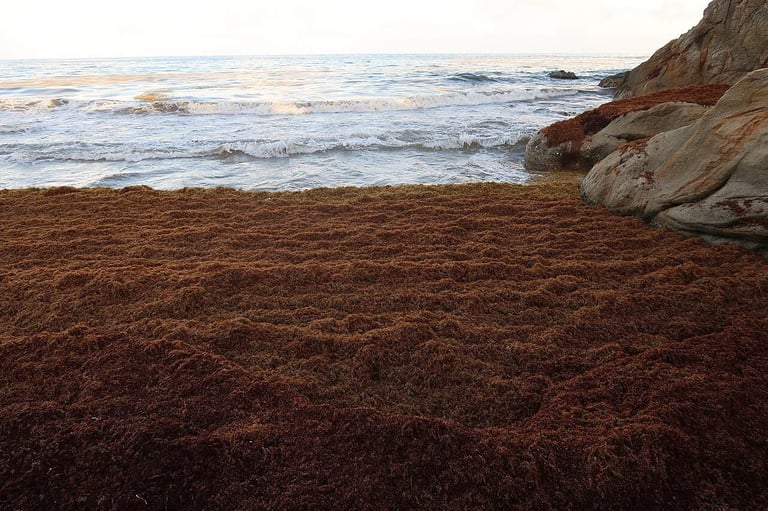

Experiments show rapid biomass doubling under nutrient-rich conditions, with neritic (coastal) waters supporting faster growth than the open ocean.
Forecasting and management implications include the need for international monitoring, improved forecasting models, and strategies to reduce nutrient runoff, while acknowledging that reductions in pollution may not completely turn off the Atlantic bloom due to complex oceanic and biological interactions.
The belt’s distribution is shaped by ocean currents, notably the Loop Current and Gulf Stream ferrying Sargassum from the Gulf of Mexico into the Atlantic, while regional shifts occur (e.g., a decline in the north Sargasso Sea post-2015) possibly tied to Gulf of Mexico warming and marine heatwaves.
Sargassum mats recycle nutrients within their ecosystems, supporting localized nutrient supplies through microbial activity and excretions from resident marine life, a process increasingly modeled to explain observed bloom variability.
Two major nutrient pathways are identified: (1) surface nutrient supply from terrestrial inputs and equatorial upwelling that mobilizes phosphorus, enabling microbial nitrogen recycling, and (2) subsurface nutrient sources observed during 2024-2025 experiments, where nutrients below the mixed layer boosted growth.
Nutrient availability—especially nitrogen and phosphorus—is central to the belt’s productivity, with land-based inputs (agricultural runoff, wastewater, atmospheric deposition) increasingly implicated as nutrient sources over natural upwelling and mixing.
The Great Atlantic Sargassum Belt (GASB) is a broad, multi-decade phenomenon where millions of metric tons of floating brown seaweed span the Atlantic, first dramatically observed in 2011 and recurring annually with varying size.
The ecological and economic impacts are mixed: the belt provides habitat for hundreds of species, including young sea turtles, but can smother corals and seagrasses and release hydrogen sulfide as it decomposes, affecting coastal communities.
A 2025 review from Florida Atlantic University synthesizes four decades of data to explain the belt’s growth, distribution, and variability, highlighting its seed sources, nutrient drivers, and physical transport mechanisms.
Summary based on 1 source
Get a daily email with more Science stories
Source
ZME Science • Oct 26, 2026
A Massive Seaweed Belt Crosses the Atlantic. Scientists Are Rethinking What Feeds It