Groundbreaking Study Maps Genetic Influence on Immune Cell Gene Expression and Chromatin Accessibility
October 28, 2026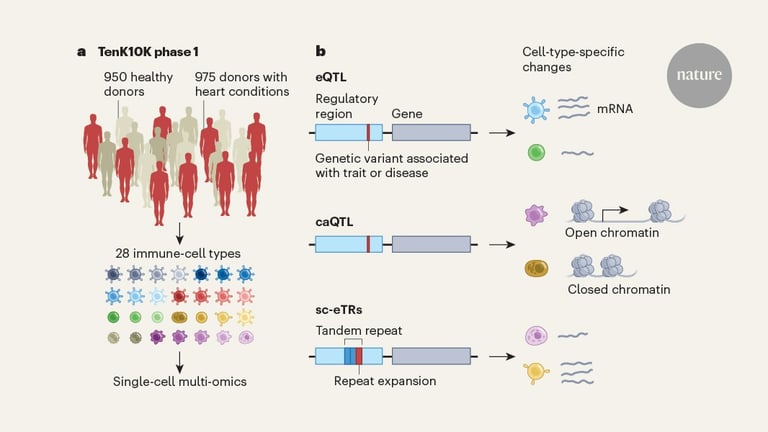

The study uses SAIGE-QTL to map common-variant eQTLs (MAF > 1%) across 28 immune cell types, identifying 154,932 eQTLs affecting 17,674 genes at FDR < 5%, with power varying substantially by cell type due to differences in cell counts.
There is substantial colocalization between eQTLs and diseases/traits, with over 60,000 colocalization events involving more than 5,000 genes, and the team applies scDeepID to map dynamic eQTLs along continuous cell-state trajectories, uncovering 15,000+ eQTLs that vary with cell-state progressions.
Integrating regulatory annotations (PromoterAI, SpliceAI) and open-chromatin data (scATAC-seq) enhances detection of rare-variant eQTLs, including examples in SH2D2A, PRDM4, TMED3, and CLDND2.
Related articles and references guide readers to primary research on how rare and common variants shape single-cell immune gene expression and chromatin accessibility linked to disease risk.
The collaboration involves the Translational Genomics Research Institute (TGen) and researchers Heini M. Natri and Nicholas E. Banovich.
The decade-scale effort aims to diversify cohorts and increase resolution of regulatory-variant links to health outcomes, improving understanding of gene regulation in specific cell types.
Including caQTL data improves GWAS colocalization by about 9.8% on average; adding bulk eQTLs boosts signals further, and cell-type-resolved caQTLs capture signals invisible to bulk analyses.
Exploration of rare caQTLs identifies 216,159 rare caQTLs across 26 cell types, with several examples where rare variants disrupt transcription factor motifs to modulate distal regulatory elements and gene expression.
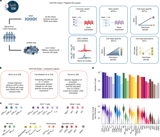
A large-scale study maps genetic variation's influence on chromatin accessibility at single-cell resolution in human immune cells, addressing missing regulatory insights behind many GWAS signals.
Fine-mapping with SuSiE identifies 7,131 genes with at least one independent signal, including many non-primary signals farther from the TSS and enriched in enhancers.
Fine-mapping and replication show high-confidence caQTLs, with 88.56% of credible sets containing a single variant and strong concordance among caQTLs, allele-specific accessibility, and ChromBPNet predictions.
Coloc and SMR analyses link caQTLs to gene regulation, revealing cell-type-resolved regulatory effects and bidirectional peak–gene relationships across cell types, illustrating complex context-dependent regulation.
Summary based on 3 sources
Get a daily email with more Science stories
Sources
Nature • Oct 28, 2026
Rare and common genetic variants shape single-cell immune gene expression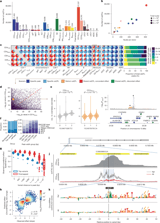
Nature • Oct 28, 2026
Genetic variants shape single-cell chromatin accessibility and disease risk