Breakthrough Eutectic Engineering Boosts Perovskite Solar Cell and LED Performance
November 5, 2026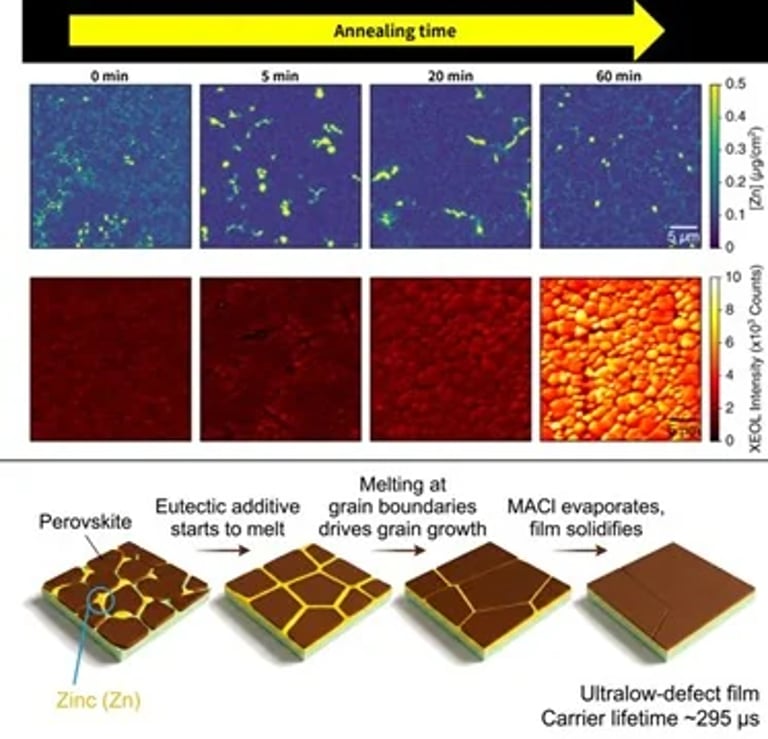

A collaborative team led by Seong Sik Shin at SKKU SAINT, with partners KRICT, UC San Diego, and Princeton University, developed ultra-low-defect perovskite semiconductor thin films through a novel volatile eutectic-engineering approach.
This method enables high-performance solar cells and LEDs within a single device architecture, showcasing dual functionality.
The defect reduction relies on a volatile eutectic mixture of methylammonium chloride (MACl) and zinc halide (ZnX2), which melts at a lower temperature and forms a liquid grain-boundary layer around 100°C to promote rapid, defect-suppressing grain growth.
During heating to about 100°C, the MACl–ZnX2 mixture creates a liquid grain-boundary layer that enables rapid diffusion and growth of large, defect-suppressed crystal grains.
Remarkably, the same device architecture used for solar cells also functions as LEDs, achieving an external quantum efficiency of 26.1%.
The resulting films exhibit a charge-carrier lifetime of roughly 295 microseconds and a surface recombination velocity around 0.3 cm/s, among the lowest reported for lead halide perovskites.
The research points to broad potential applications beyond solar cells and LEDs, including other optoelectronic devices, displays, and photodetectors, with implications for wider materials science use.
Shin described this as the world’s first crystal-growth method based on a volatile eutectic that substantially reduces defects without the need for expensive equipment.
The study, published in Science on October 8, 2026, was led by Shin, Fenning, and deQuilettes, with co-authors Nam, Yoo, and Dolan, and supported by Korea’s Ministry of Science and ICT and NRF.
Dr. Seongsik Nam highlighted that the surface recombination velocity is among the lowest reported for perovskite thin films, signaling improved surface quality suitable for large-area fabrication.
Solar cells made with these films achieved a certified efficiency of 25.9% (with reports of 26.5%), and an open-circuit voltage of 1.208 V, setting a record for this device architecture.
During annealing, MACl evaporates while zinc migrates to grain boundaries, further suppressing defects and enhancing film quality.
Summary based on 3 sources
Get a daily email with more Science stories
Sources

Mirage News • Nov 5, 2026
SKKU Develops Low-Defect Films for Solar Cells and LEDs
Asia Research News • Nov 5, 2026
SKKU Develops Ultra-Low-Defect Semiconductor Thin Films through Eutectic Engineering, Enabling Both Solar Cells and LEDs