Sugar Tags and Importin-β Keep Nuclear Pore Barriers Fluid, Study Finds
November 11, 2026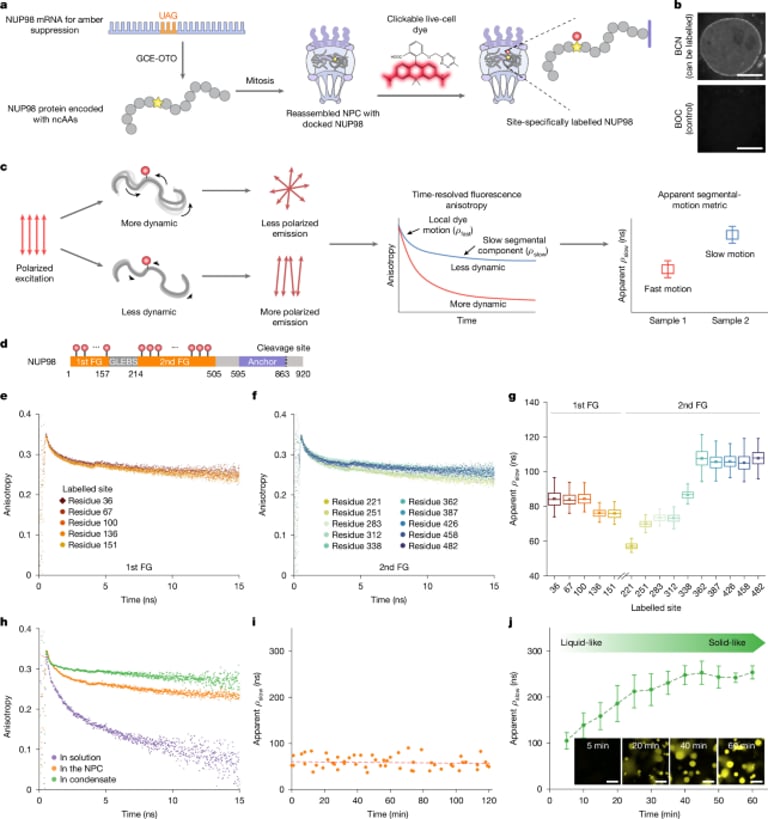

A study published in Nature, “Glycosylation and importins liquefy the FG barrier in live nuclear pores,” finds that sugar modifications and the transport protein importin-β help keep the barrier inside nuclear pores fluid and able to support transport.
Researchers from Johannes Gutenberg University Mainz, the Max Planck Institute for Biophysics and Wuhan University studied NUP98, a key barrier protein, using fluorescent labelling in living cells alongside purified-protein experiments and molecular simulations.
In living cells, NUP98’s flexible FG domains remained highly mobile, while purified condensates initially resembled the cellular state but gradually slowed and developed amyloid-like features.
The proteins remained mobile during a two-hour observation in living cells, whereas isolated proteins hardened into a gel-like or solid mass over roughly the same period.
Adding the sugar modification O-GlcNAc to purified NUP98 delayed condensate ageing and preserved liquid-like motion, including in an aggregation-prone region.
In living cells, blocking the enzyme that adds O-GlcNAc reduced the modification, slowed NUP98 motion and significantly slowed nuclear import; blocking the enzyme that removes it had little additional effect.
Importin-β made purified FG condensates more mobile and delayed their shift toward a solid-like state, but could not reverse solidification once the condensates had matured.
Simulations suggest importin-β binds FG domains, diluting the condensates and reducing contacts between aggregation-prone NUP98 regions, which may help protect them from molecular ageing.
Simulations predicted importin-β would concentrate near the pore’s periphery while expanded FG domains remained in the central channel; DNA-PAINT MINFLUX imaging in fixed cells supported that arrangement.
The simulations also suggested that most transport passes along the pore’s edge, without requiring a central plug to explain the route.
The molecular simulations were run on JUPITER, Europe’s first exascale supercomputer, at the Jülich Research Center.
Led by Edward Lemke and Gerhard Hummer, the research may also inform studies of neurodegenerative processes in which flexible proteins harden.
Summary based on 4 sources
Get a daily email with more Science stories
Sources
Nature • Nov 11, 2026
Proteins that form the nuclear pore barrier move like liquids
Phys.org • Nov 11, 2026
Fluorescent probes reveal fluid-like barriers inside nuclear pores of living human cells
SSBCrack News • Nov 12, 2026
Cell Culture and Transfection Techniques for Generating Doxycycline-Inducible Cell Lines for Importin-β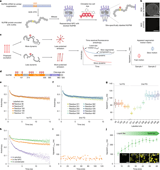
Nature • Nov 11, 2026
Glycosylation and importins liquefy the FG barrier in live nuclear pores