Euclid Releases First Major Cosmic Survey, Capturing More Than 900 Million Galaxies
November 12, 2026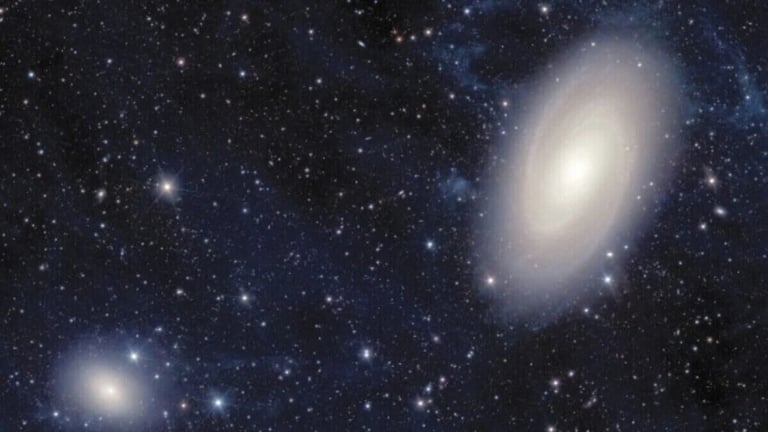


The European Space Agency’s Euclid mission has released its first major dataset, an unprecedented space-based optical and near-infrared survey containing images of more than 900 million galaxies and over 60 million potential quasars.
The release captures more than a billion celestial objects and is designed to help build a detailed three-dimensional map of the universe.
Covering 1,900 square degrees—about 30 times the area of Euclid’s preliminary release—the survey contains roughly 35 times as many galaxies and represents about 14% of the sky area planned for mapping.
The dataset combines the Wide Survey, which scans large areas for cosmology, with the Deep Survey, which repeatedly examines selected regions to find faint, distant objects and help calibrate the broader survey.
Euclid’s wide, precise view allowed it to image an area nearly 2,000 times the size of the full Moon in a year, while avoiding interference from Earth’s atmosphere.
The release features the Messier 81 galaxy group, including nearby NGC 3077, the ring galaxy NGC 1291 about 33 million light-years away, and the Abell 3128 cluster about 800 million light-years away.
A full-resolution view of Messier 81 resolves individual stars in its disc, while the NGC 1291 images show small blue dots associated with ongoing star formation.
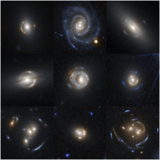
Among the survey’s notable finds are 15,000 strong gravitational lenses, whose curved arcs form when foreground mass bends light from background galaxies and can reveal the distribution of unseen matter.
Dark matter cannot be observed directly, but its gravitational effects help hold galaxies together; it is estimated to make up about 85% of the universe’s matter.
Some of the galaxies observed existed when the universe was about 700 million years old, roughly 5% of its current age, giving astronomers a view into the distant past.
Euclid has also enabled unexpected observations, including a newly discovered comet and a 26-hour survey of more than 60 million stars in the Milky Way’s central bulge to search for exoplanets.
The release includes raw and calibrated data, catalogs, spectra and large sky mosaics; early research includes a catalog of 380,000 galaxies classified by shape, and lens candidates were identified with machine learning, expert review and citizen-science efforts.
Summary based on 12 sources
Get a daily email with more World News stories
Sources

The Guardian • Nov 12, 2026
European survey reveals 900m galaxies – and possibly secrets of ‘dark universe’
Phys.org • Nov 12, 2026
Euclid offers best-ever 3D map of the universe to date
New Scientist • Nov 12, 2026
Vast data dump from Euclid space telescope reveals stunning galaxies