Euclid Finds Two of the Universe’s Earliest Quasars, Shattering Discovery Records
November 15, 2026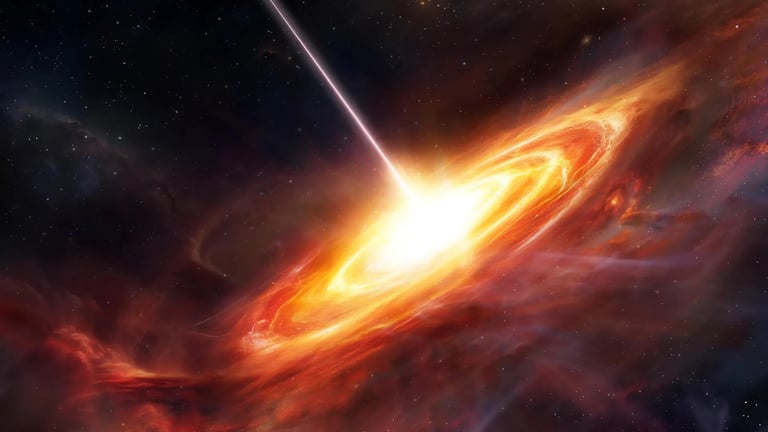

Euclid has identified 31 exceptionally ancient quasars, including two record-setters that were already shining when the Universe was about 670 million years old—roughly 5% of its current age.
Twelve of the 31 have redshifts of 7 or higher, placing them within the Universe’s first 770 million years; the two most ancient have redshifts of 7.77 and 7.69 and are just over 13 billion light-years from Earth.
The previous record-holder, discovered in 2021, had a redshift of 7.64, while Euclid found more quasars at redshift 7 or higher in one year than astronomers had identified in more than a decade of earlier searches.
All 31 discoveries came from Euclid’s Wide Survey, planned to cover more than one-third of the sky, whose broad reach, sharp and deep imaging, and space-based infrared observations make it well suited to finding rare, distant objects.
Euclid’s wide-ranging, sensitive observations have also picked up fainter ancient quasars that earlier searches often missed, giving astronomers a more representative view of this population.
These quasars date to the epoch of reionization, when energetic radiation transformed the Universe’s gas after the earlier cosmic dark ages.
Quasars are brilliant galactic cores powered by material spiraling into supermassive black holes, and studying the earliest examples can reveal how the first galaxies and black holes formed and grew.
Although Euclid’s primary mission is to investigate the dark Universe, its growing quasar discoveries may help explain how supermassive black holes became so large so soon after the Big Bang.
Follow-up observations found the second most ancient quasar in a gas- and dust-rich galaxy where stars are forming rapidly, offering clues to how early massive galaxies developed alongside their central black holes.
Summary based on 1 source
Get a daily email with more Science stories
Source
ScienceDaily • Nov 14, 2026
Euclid discovers ancient cosmic beacons from the dawn of time, shining like a trillion suns