Nvidia Unveils Rubin HPC for Scientific Computing, but Key Specs Remain Unknown
November 17, 2026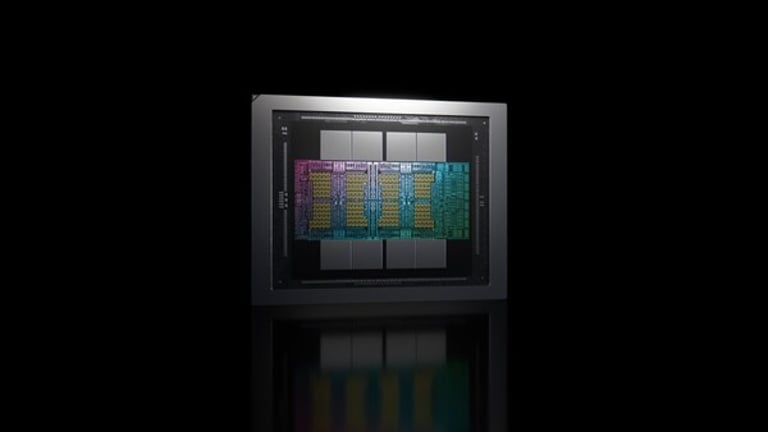


Nvidia unveiled Rubin HPC at the SC26 supercomputing conference on November 16, a Rubin GPU variant built for high-performance computing and scientific workloads that is expected to arrive in 2028.
The GPU has more than 50,000 CUDA cores and combines that count with sparse-data acceleration and seventh-generation NVLink, targeting matrix operations, stencil computations, sorting and reductions; Nvidia has not explained how the acceleration works or released simulation benchmarks.
Nvidia has yet to disclose Rubin HPC’s HBM memory capacity or bandwidth, or whether it will emphasize native FP64 double-precision performance—a capability central to scientific computing.
The AI-focused Rubin was rated at 33 teraFLOPS of FP64 performance, below Nvidia’s previous Blackwell and Hopper GPUs, although Nvidia says memory bandwidth could benefit sparse workloads and emulated FP64 matrix operations could reach 200 teraFLOPS in some cases.
Nvidia is targeting climate modeling, engineering simulations, genomic research and financial risk analysis, as well as simulations that help AI agents test scientific and engineering ideas.
The broader pitch is to use AI agents to propose materials, molecules and designs, then run simulations that help researchers test hypotheses and decide what to investigate next.
Rubin HPC will work with Nvidia’s CUDA-X libraries, which provide optimized algorithms for simulation and analytics; Nvidia says faster simulations could let research teams evaluate more possibilities and better prioritize physical experiments.
Ian Buck, NVIDIA’s vice president of hyperscale and high performance computing, said faster simulations can shorten research timelines by helping scientists test more possibilities and guide experiments.
Nvidia also introduced Nemotron for Science, combining the Nemotron 3.5 Super VL open-source model, post-training workflows for scientific tasks and nearly 50,000 chemistry questions for training and evaluation.
For other science workloads, Nvidia says its cuPhoton.xBeam library can analyze Event Horizon Telescope data in eight minutes, compared with about a month for the previous process, while cuPhoton.xLens supports plasma simulations for fusion reactors.
Nvidia is also open-sourcing cuSpa to speed cell-polygon calculations in biology research and offering the existing rapids-singlecell tool in a containerized format.
The announcement comes amid competition from AMD, which introduced its HPC-focused Instinct MI430X with 432 GB of HBM4, up to 23.3 TB/s of memory bandwidth and projected peak FP64 performance of 288 teraFLOPS; it is expected to launch in 2027, and AMD says the engineering projections may change.
Summary based on 11 sources
Get a daily email with more Tech stories
Sources

theregister • Nov 17, 2026
GPU giants throw HPC users some tasty crumbs
SiliconANGLE • Nov 17, 2026
At SC26, Nvidia debuts new Rubin HPC chip, scientific research libraries
TechSpot • Nov 17, 2026
Nvidia reveals Rubin HPC, a GPU with 50,000+ CUDA cores for scientific simulation
Tech Times • Nov 17, 2026
Nvidia Rubin HPC Debuts With 50,000+ Cores; Top Supercomputers Hit 3 Percent of Peak on Sparse Code